
Key Takeaways
What you'll learn in this article
- Teach the exact place the hook enters, not just the finished movement.
- Use a smooth, solid-color teaching swatch when the project yarn hides individual loops.
- Record a pause before insertion, the complete movement, and the resulting stitch without cutting away.
- Test whether a learner can identify the next insertion point on a phone screen before publishing.
Key Takeaways
- Teach the exact place the hook enters, not just the finished movement.
- Use a smooth, solid-color teaching swatch when the project yarn hides individual loops.
- Record a pause before insertion, the complete movement, and the resulting stitch without cutting away.
- Test whether a learner can identify the next insertion point on a phone screen before publishing.
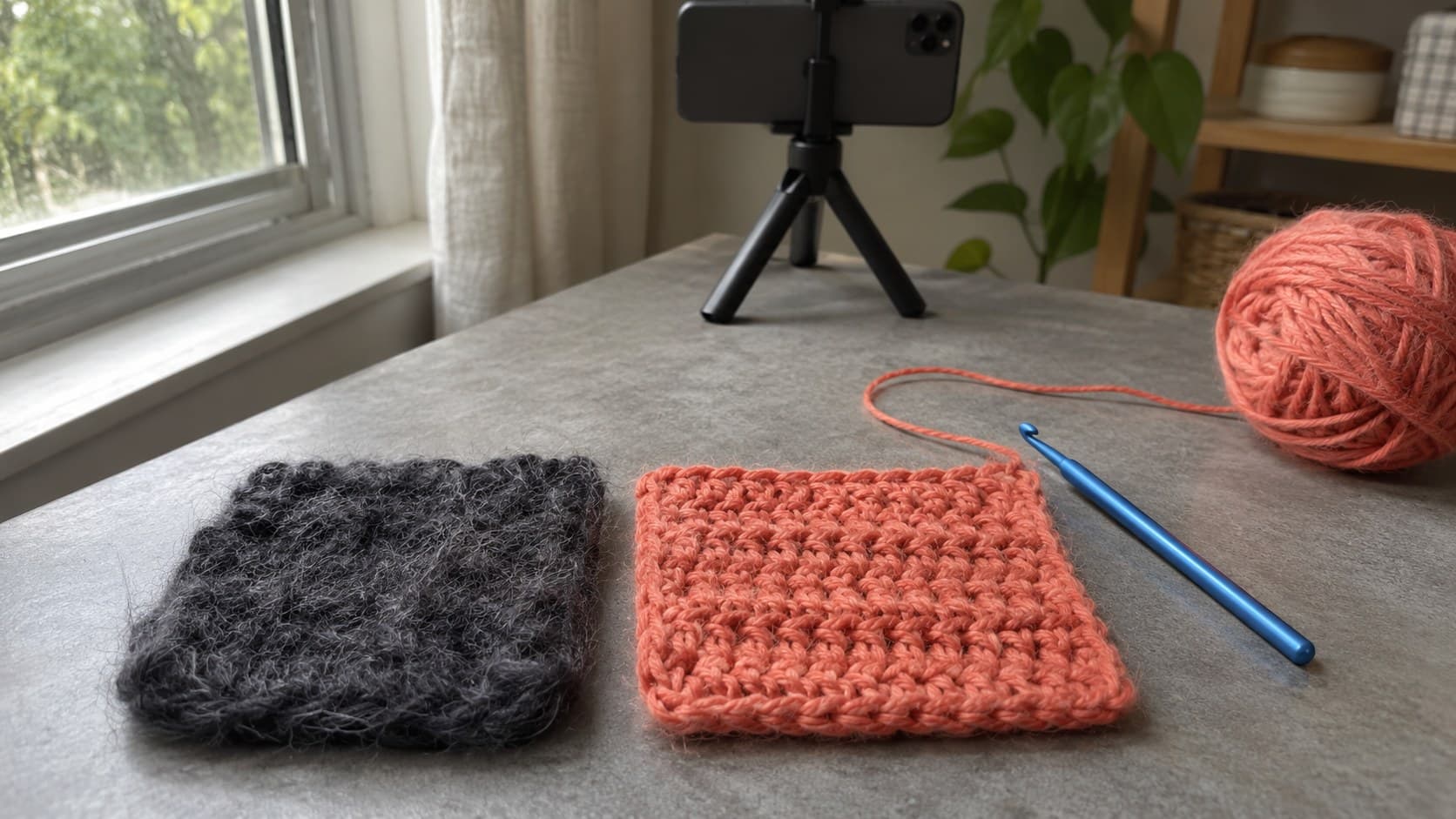
To make crochet tutorial videos easier to follow, separate stitch visibility from stitch speed. Show the target loop or space clearly, pause before inserting the hook, and keep the action visible through the finished stitch. If dark, fuzzy, or multicolored yarn hides that decision, demonstrate the technique on a contrasting teaching swatch before returning to the actual project. Slowing down an unclear view does not make the missing detail appear.
This is a filming and teaching workflow, not an algorithm trick. The goal is a viewer who knows where to put the hook next—not simply a prettier close-up.
Find the decision your camera is hiding
Watch your draft without listening to the narration. At the instant before insertion, can you identify the exact loop, stitch, or space being used?
A recognizable hook and a sharp picture are not enough. Your fingers may cover the entry point. A fluffy halo may hide the loop boundary. The hook may pass through so quickly that viewers see the pull-through but miss the choice that made it possible.
Write down one visual question for the next post:
- Which of these two loops does the hook go under?
- Is the hook entering a stitch or the space beside it?
- Where does the next stitch begin after turning?
- What should remain visible after the hook passes through?
Choose one. A post that tries to answer all four can become a pattern walkthrough rather than a focused repair. Keep the original project nearby so you can show why this small detail matters.
Choose teaching yarn for visibility, not aesthetics
Your finished project and your demonstration do not have to use the same yarn. They do need to make the relationship between the technique and the finished result honest.
For a visibility test, start with smooth yarn in one solid, moderately light color. Put it against a plain surface that differs from both the yarn and your hook. Record a short sample before preparing a full lesson.
These are practical starting points, not universal material rules. Very pale yarn can lose detail under bright light. A shiny hook can reflect glare. A dark background may work beautifully for one swatch and poorly for another. Judge the recorded image, not how attractive the desk looks in person.
Make a small swatch with enough established fabric to hold comfortably. If your actual lesson is about the starting chain, use a chain; otherwise, do not force viewers to distinguish the target stitch inside a tiny, twisting foundation when a stable sample would teach it better.
When changing yarn or hook size, say that this is a visibility sample. Do not imply that its gauge, drape, or finished dimensions will match the project. If the technique itself changes with the substitution, the sample is not an adequate replacement.
Run a short light-and-angle test
Before recording the explanation, place the swatch where your hands will actually work. Test with your hands present: an empty desk can be well lit while your fingers cast a shadow over the important loop.
- Record the swatch at rest, then move the hook toward the target stitch.
- Review the clip at normal phone size rather than enlarging a desktop preview.
- Move the light slightly to the side if the stitch structure looks flat.
- Change the viewing angle if your hook hand blocks the entry point.
- Repeat until both the target and the hook remain distinguishable.
Avoid changing everything at once. Keep the swatch fixed while testing the light, then keep the light fixed while adjusting the camera. This makes it easier to tell which change helped.
Get close enough to show the relevant loops without cropping out all orientation. Viewers still need to know which edge they are looking at and which direction you are moving. A detail shot with no context can be as confusing as a wide shot with no detail.
Film three states of the same stitch
Clear crochet tutorial videos preserve the relationship between the choice, the movement, and the result. Record those as three states of one continuous demonstration.
Before: reveal the entry point
Hold the work still and move any covering finger slightly aside. Use the hook tip to indicate the target without pushing into it immediately. State exactly what the viewer should identify.
For example, a back-loop lesson needs the viewer to distinguish the two top loops before you name the one being used. If your angle makes them overlap, adjust the fabric instead of adding a longer explanation over the same unreadable view.
During: keep the passage visible
Insert the hook slowly enough to see where it passes. Avoid a cut between pointing and insertion; that edit can remove the very evidence the learner needs.
Maintain workable tension rather than stretching the fabric into an exaggerated opening that will disappear when the learner tries it normally. If you temporarily spread the fabric to identify a feature, show its normal position again before continuing.
After: show what changed
Finish the movement and pause. Show the resulting stitch and identify the next target. Then repeat once at a comfortable working pace, preserving the same orientation.
This second demonstration helps distinguish a repeatable action from a carefully staged still frame. It also exposes whether your fingers return to a position that hides the next decision.
Edit around understanding, not every motion
Remove setup delays, not the transition that explains the technique. Keep the entry-point pause, the insertion, and the result together even if you shorten the introduction.
Use a short label only when it resolves an ambiguity. Place it away from the hook and active stitches, and review the draft inside the posting preview so interface elements do not cover the lesson. A bright arrow is not a substitute for visible yarn structure.
If you narrate, describe the action the viewer can see. If you use music, keep the spoken instruction intelligible. Silence is also a valid choice for a close-up that works through clear visuals and concise captions; a rising sound is optional, not a requirement for teaching well.
Return briefly to the actual project after the contrasting sample. Point out the corresponding location in its yarn so learners can transfer the lesson. If that location still cannot be seen, explain the limitation rather than presenting the dark or fuzzy version as equally readable.
Test identification before asking for imitation
Hand the preview to someone who understands the lesson's prerequisites. Pause immediately before insertion and ask them to point to the target. Do not guide their finger or finish the answer for them.
If they choose the wrong place, ask what they used to decide. Their answer can separate a visibility problem from an unfamiliar term. Refilm the view for the first problem; explain the term for the second.
Then let them watch the full movement and locate the next target. This is a more specific check than asking whether the video was clear. It tests the decision your post is supposed to teach.
For crochet tutorial videos, a useful pre-publication standard is simple: the viewer can identify where the next stitch begins without relying on your hand to hide the uncertainty.
A hypothetical repair for a dark-yarn lesson
Suppose you have filmed a charcoal scarf demonstration, but a reviewer cannot distinguish the loop you use. The camera is focused and the narration is accurate; the yarn texture is the obstacle.
Instead of rerecording the entire scarf tutorial, make a smooth coral teaching swatch. Open with the specific problem: “Can't tell which loop to use? Watch this stitch before the hook goes in.”
Show the two loops, pause on the chosen one, complete the stitch, and repeat. Finish with a short return to the charcoal scarf, identifying the equivalent location without promising identical visibility. This hypothetical repair changes the teaching view, not the pattern or the claimed result.
Turn the clarity fix into a useful next post
Package the lesson around the learner's question. “Where the hook goes for this stitch” is a more accurate promise than “The crochet secret nobody tells you.” Use the hook generator to explore openings, then reject any version that promises more than the footage teaches.
InsightTok AI can help turn the verified lesson into a next-post plan through Next Post Studio: useful hooks, a niche-relevant rising sound if appropriate, and an account-informed posting time. Its “next post planned in 90 seconds” positioning concerns planning—not replacing the filming and learner checks above.
After publishing, assess understanding separately from reach. TikTok's official Studio documentation describes account and video analytics, viewer activity times, and engagement insights including comments. Available tools can vary, so use what your account exposes.
Read comments for specific remaining confusion, then compare available performance signals with similar lessons after the same observation period. A larger view count alone cannot establish that the entry-point demonstration worked. A repeated question about the same loop gives you a concrete next revision, even on a post that attracted attention.
Use InsightTok AI to support that planning decision without turning one video's metrics into a universal rule. Keep the next test narrow: preserve the technique and change the view that still needs explanation.
Ready to package a clearer lesson? Plan your next post around one stitch your viewers can finally see.
InsightTok AI Team
Expert in TikTok growth strategies and social media analytics. Helping creators reach millions with data-driven insights and AI-powered recommendations.
Ready to Grow Your TikTok?
Get AI-powered analytics and content recommendations to boost your views and engagement.
Start Free TrialRelated Posts

TikTok Brand Deals in 2026: A Budget Compression Framework for Faster Approvals
Learn how to navigate compressed brand budgets, procurement delays, and growing variation requests in 2026. This practical framework helps TikTok creators secure faster decisions while protecting their rates, calendars, and rights.
Pottery TikToks: Show When Clay Is Ready to Trim
Make pottery TikToks that explain clay readiness with honest sample comparisons, clear handling checks, and a real-time trimming shot.

Why 50K TikTok AI Shopping Impressions Produce Zero Cart Adds—and How to Fix It in 2026
Learn why high TikTok shopping impressions may produce few cart adds—and how to fix the conversion gap. Use the MATCH framework to improve product relevance, trust, and purchase flow.