
Key Takeaways
What you'll learn in this article
- Compare two products for one real use case, not for an undefined title of “best.”
- Decide the test conditions before filming and show the evidence behind your recommendation.
- Separate what you observed from personal preferences and claims you have not tested.
- Finish with who each option suits, then use audience questions to choose the next comparison.
Key Takeaways
- Compare two products for one real use case, not for an undefined title of “best.”
- Decide the test conditions before filming and show the evidence behind your recommendation.
- Separate what you observed from personal preferences and claims you have not tested.
- Finish with who each option suits, then use audience questions to choose the next comparison.
To make a useful TikTok product comparison video, choose one buyer decision, test both options under comparable conditions, and show the result before giving a qualified recommendation. The goal is not to manufacture a winner. It is to help a specific viewer understand which trade-off matters for their situation.
This guide is for creators comparing physical products they can actually demonstrate: storage containers, desk accessories, craft supplies, everyday tools, and similar items. It is not a laboratory-testing standard, a guarantee of sales, or a reason to make health or safety claims from a casual demonstration.
Start with a decision, not two objects
“Which one is better?” is too broad to guide filming. Better for whom, doing what, under which constraint?
Replace that question with a concrete choice:
- Which lunch container fits this commuter bag more conveniently?
- Which desk stand is easier to reposition in this small workspace?
- Which storage box lets me retrieve these supplies without unpacking everything?
Each question gives the viewer a reason to care and gives you an observable task. You can still mention other differences, but one decision should organize the post.
Choose products that are genuine alternatives for that task. Comparing a travel-sized item with a large home version may be useful if the question is portability; it is misleading if you pretend they were designed for identical capacity.
Before buying anything new, check the relevant questions already appearing under your posts. Look for a specific obstacle, not simply a popular brand name. If the audience keeps asking whether something fits a small desk, another general unboxing will not answer the question.
Write a fair-test brief before recording
A fair comparison does not mean making different products identical. It means avoiding preventable differences in your setup that determine the result before the products get a chance.
Write a short private brief with these fields:
| Field | What to record |
|---|---|
| Viewer | The person and constraint this comparison serves |
| Task | The exact action both products will attempt |
| Starting condition | Relevant setup, contents, charge, assembly, or settings |
| Evidence | What the camera must show to support the conclusion |
| Limitation | What this test cannot establish |
For a bag-fit comparison, use the same bag and packing task. For a desk stand, use the same device and work surface, within each stand's stated compatibility. Follow the manufacturers' instructions rather than setting up one option incorrectly to create a dramatic contrast.
If the products require different setup, show that difference. Ease of assembly may be part of the decision. Do not quietly prepare one product off-camera while making the other look difficult in real time.
Record the exact models and relevant versions in your notes. Prices, bundles, materials, and dimensions can differ between versions that look similar. If price matters to your verdict, identify the price you checked and avoid presenting a temporary offer as a permanent advantage.
Decide what would change your mind
Before testing, write down the evidence that would make you recommend each option. This is a practical guard against filming only the result you hoped to get.
If one product was gifted or you earn commission from it, that relationship should not change the conditions. Keep the same task and evidence standard. When you cannot test an important claim, say it remains untested rather than borrowing confidence from the packaging.
Film evidence the viewer can inspect
A TikTok product comparison video needs enough visible context to make its conclusion understandable. A fast montage of attractive objects is not a comparison if the decisive action happens between cuts.
Use a simple recording sequence:
- Show both options and state the task.
- Show the shared starting conditions.
- Perform the task with the first option.
- Repeat it with the second under comparable conditions.
- Show the detail that explains your recommendation.
Keep framing, lighting, and playback speed consistent where those choices affect interpretation. Do not brighten one result, hide a failed attempt, or speed up only one product's setup while presenting the edit as a direct performance comparison.
For a timed claim, preserve a clear record of how you measured it. For a fit claim, show the object actually fitting. For a noise comparison, background music can obscure the very evidence viewers need to hear.
One attempt may be enough to show a physical fit in your setup. It is not enough to establish reliability, long-term durability, or universal superiority. Repeat a variable task when practical, report mixed results honestly, and distinguish an informal demonstration from controlled testing.
You do not need a split screen. Sequential shots may make small details easier to see on a phone. Choose the layout that exposes the evidence, not the one that looks most technical.
Give a conditional verdict
Separate three kinds of statements in your script:
- Observation: “This container fits upright in the bag I used.”
- Preference: “I prefer this lid because it is easier for me to open.”
- Untested claim: “I have not tested whether it stays sealed during a commute.”
That separation helps you avoid turning a narrow demonstration into an unsupported promise. A container fitting upright does not establish that it is leakproof. A stand holding one device does not prove it can safely hold every tablet.
Use this closing structure: choose the first option if this constraint matters most; consider the second if that other trade-off matters more; here is what I did not test.
A tie is acceptable. So is recommending neither. If the products perform similarly on the chosen task, explain the remaining difference rather than inventing a dramatic winner.
A hypothetical lunch-container comparison
Imagine a home-organization creator whose viewers ask which container works in a narrow commuter tote. This is an illustrative scenario, not a real customer result.
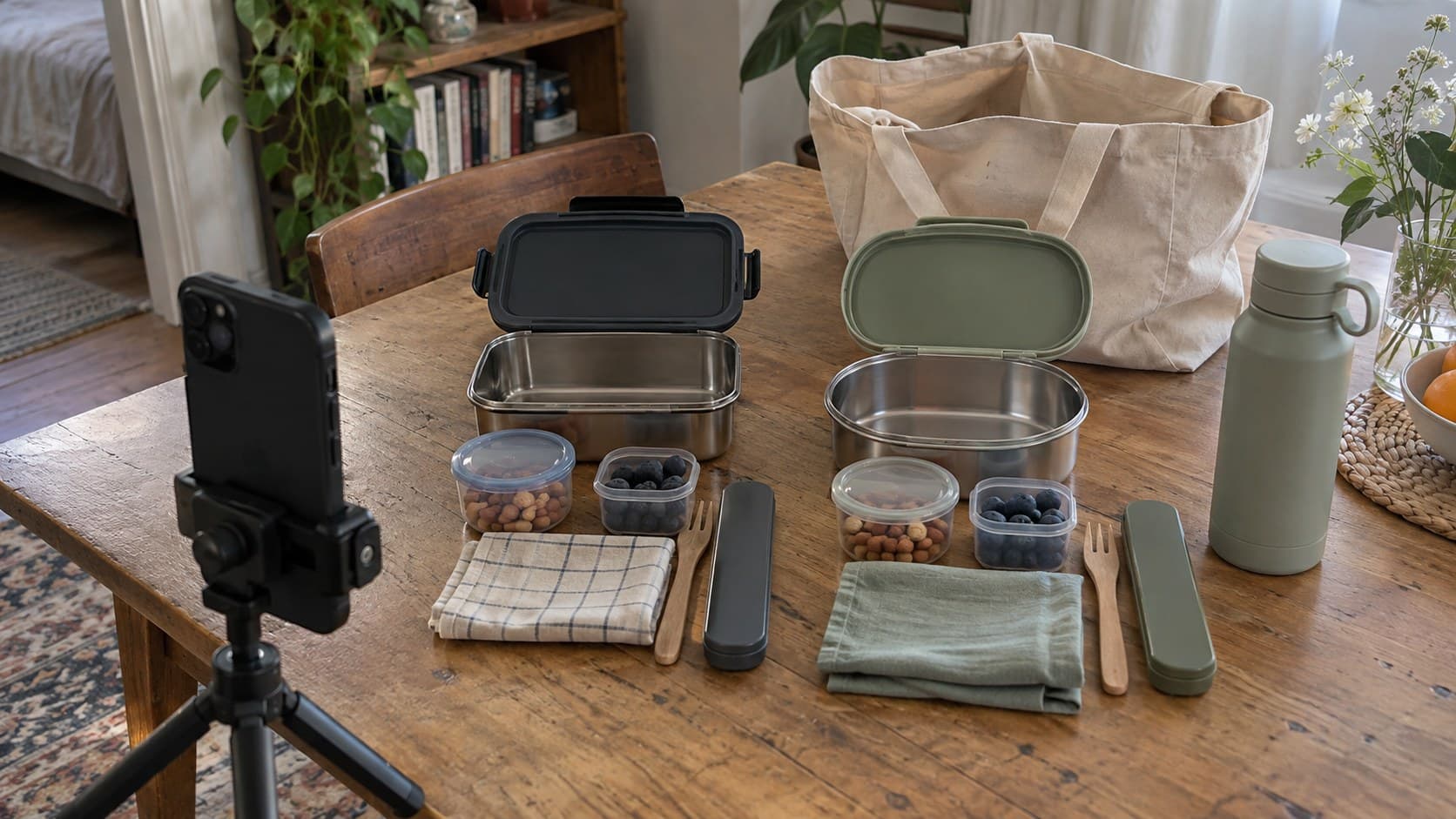
The creator uses the same tote, the same lunch items, and the same surrounding bag contents for both demonstrations. They show how each container sits inside and how easy it is to retrieve without emptying the bag.
Their opening could be: “Choosing a lunch container for a narrow work bag? Here is how these two fit with the same lunch.”
Their verdict would follow the actual footage. If both fit, the useful distinction might be access rather than capacity. If only one fits upright, that is the finding for this bag—not proof that the other is badly designed. Leak resistance and insulation stay outside the verdict unless separately tested.
Keep disclosures and music separate from the verdict
TikTok's current content disclosure guidance requires the disclosure setting for content that promotes a brand, product, or service. Its examples include promoting your own business and third-party promotion in exchange for payment or another incentive.
Check the relationship behind the post before publishing. Use the applicable platform disclosure and make the relationship understandable in the content; also follow the advertising rules that apply to you. A balanced review does not erase a commercial relationship.
For promotional content, TikTok recommends music from its Commercial Music Library. Its commercial music guidance says its licenses for music outside that library do not cover commercial use in content. Other music requires the necessary rights. A sound being popular or suggested by a planning tool is not proof of commercial clearance.
Silence or clear spoken narration may suit the demonstration better than a soundtrack. Never let music conceal sound that forms part of the comparison.
Turn the comparison into a next-post plan
Once the evidence is ready, use the conclusion to write the hook—not the other way around. The free TikTok hook generator can help you explore openings, but reject wording that adds a “best ever” claim your test cannot support.
InsightTok AI can help package the next post through Next Post Studio, bringing together hook options, a niche-relevant rising sound, and an account-specific posting-time recommendation. Those are planning inputs, not product-test validation or music licenses.
Keep a compact brief beside the recording: viewer, decision, shared conditions, evidence shot, verdict, limitation, disclosure, and sound choice. Then select a realistic posting window. A scheduling recommendation cannot make an unfair demonstration more useful.
After publishing, review comparable posts over the same observation period. TikTok Studio's documentation describes account and video analytics, viewer activity times, and engagement insights; available features vary. Use the fields your account provides rather than assuming every interface exposes identical metrics.
Read the questions alongside those numbers. “Does it fit a wider bottle?” suggests a new use case. “Were both assembled correctly?” suggests a missing explanation or a test that needs repair. Views alone cannot tell you which problem the next post should solve.
For your next TikTok product comparison video, change the buyer question only when the evidence supports it. A second comparison can test a different constraint without repeating the same recommendation under a new headline.
Choose two relevant alternatives today, write one fair-test brief, and record the decisive action. When you want help turning that evidence into a hook, sound choice, and posting window, start a next-post plan with InsightTok AI.
InsightTok AI Team
Expert in TikTok growth strategies and social media analytics. Helping creators reach millions with data-driven insights and AI-powered recommendations.
Ready to Grow Your TikTok?
Get AI-powered analytics and content recommendations to boost your views and engagement.
Start Free TrialRelated Posts
Why Curiosity-Driven Questions Earn 3-6x More Monthly Revenue Than Trend Chasing in 2026: The Niche Question-to-Community Monetization Framework to Build Loyal Audiences, Convert Comment Participation Into Recurring Revenue, and Escape the Trend-Dependent Algorithm Trap
This guide explores how curiosity-driven content can increase revenue on TikTok in 2026. Discover the Niche Question-to-Community Monetization Framework and start building a loyal audience today.
Why Your Behind-the-Scenes Content Gets Views But Zero Shop Conversions: The Authenticity-to-Commerce Framework to Turn Messy Process Videos Into $800-$2000+ Monthly From Unfiltered Audiences in 2026
This blog post unravels an Authenticity-to-Commerce framework to help TikTok creators monetize their behind-the-scenes content effectively.
Why Your Trend-Chasing Content Died in 2 Days But Top Creators Earn $400-$900+ Monthly From Single Searchable Videos: The Evergreen-to-Trend Hybrid Framework to Convert Viral Moments Into 6-Month Passive Revenue Without Abandoning Trend Participation in 2026
This post explores the transition from trend-chasing to evergreen content on TikTok in 2026, offering a hybrid framework for creators seeking sustainable income.