
Key Takeaways
What you'll learn in this article
- Pair each fired glaze tile with an identifiable recipe record, not just a beautiful reveal.
- Show the clay body, glaze order, application method, and firing context that produced your sample.
- Keep the full tile visible before moving in for texture and surface details.
- Treat your result as one documented studio test, not a promise that another potter will get the same finish.
Key Takeaways
- Pair each fired glaze tile with an identifiable recipe record, not just a beautiful reveal.
- Show the clay body, glaze order, application method, and firing context that produced your sample.
- Keep the full tile visible before moving in for texture and surface details.
- Treat your result as one documented studio test, not a promise that another potter will get the same finish.
Useful glaze test tile TikTok videos connect a finished surface to the process that produced it. Start with the fired tile, identify the question you tested, and show the recipe and conditions before giving your conclusion. That turns “What glaze is this?” into a post viewers can understand and refer back to, rather than another reveal with missing instructions.
You do not need to film an entire kiln cycle or turn a short video into a ceramics class. You need a reliable connection between the object on camera and the notes behind it. The workflow below is an editorial method for making that connection visible, not a universal glaze recipe or a promise of TikTok reach.
Pick one question the tile can actually answer
A bench full of tests offers plenty of footage, but it can create an unfocused post. Choose one question before arranging the tiles:
- What did this specific glaze combination look like on your clay body?
- How did reversing the layering order change your samples?
- What happened where the glaze crossed a raised texture?
- Which recorded application produced the surface you prefer for your next project?
Do not combine all four into one explanation. A viewer who wants the layering order should not have to reconstruct it from a montage of unrelated pots.
Your conclusion should match the strength of the test. If two tiles used different clay bodies and different application methods, you can show that the results differ. You cannot fairly attribute the difference to layering order alone. Say what changed, what stayed consistent, and what you would test next.
This matters beyond careful wording. Mayco’s glaze-combination guidance explicitly identifies clay body, glaze thickness, firing process, and temperature as factors affecting fired results. It recommends testing before use. A recognizable glaze name is therefore a starting point, not a complete explanation of a surface.
Give each sample an identity before filming
Before arranging your shot, match every tile to its actual studio record. If you cannot confidently identify a sample, do not present a reconstructed recipe as fact. You can still show an unidentified favorite, but say that the recipe is unknown and make a fresh documented test for a later post.
For a recorded sample, collect these details:
- Tile identifier and clay body.
- Exact glaze names or product codes.
- Base layer and top layer, in application order.
- Application method and the application details you recorded.
- Firing cone and atmosphere, plus relevant firing notes you actually know.
- The observation you want viewers to notice.
Keep this information in your studio notebook even if the video only displays the essential lines. Use the same identifier in your footage folder, edit notes, and post caption. This small habit prevents a particularly frustrating mistake: publishing the correct recipe underneath the wrong tile.
Do not invent a firing schedule from memory. If a shared studio fired the piece and you only know the cone, distinguish that known information from the conditions you did not record.
Explain the recipe without turning it into a guarantee
For glaze test tile TikTok videos, “two coats over two coats” can still leave important questions unanswered. Which glaze went on first? Were these brushed coats or a different application method? Which clay body is underneath?
State the sequence plainly. For example, describe the actual base glaze first, then the actual top glaze. If you use a short on-screen recipe, keep the direction consistent throughout the edit. Avoid switching between “A over B” and “A then B” without clarifying that those phrases can describe opposite orders.
Use the manufacturer’s instructions for the products involved rather than treating another creator’s coat count as a universal standard. Mayco’s page describes the specific application and firing conditions behind its examples; that context belongs with the inspiration, not in a footnote nobody can find.
A useful closing sentence is: “This is the result on my recorded clay body and firing; test it in your own setup.” It gives viewers a reasonable next action without claiming identical results.
Also separate appearance from suitability. A glossy, attractive sample does not demonstrate that a finished vessel is appropriate for food use. Follow the relevant manufacturer guidance and testing requirements for your intended use; do not present the video as certification.
Film an evidence sequence, not just a beauty pass
Keep the filming setup simple enough that you can repeat it when the next batch comes out. Work with cooled, safely handled pieces in your normal studio conditions. There is no need to open a hot kiln or interrupt a firing for a dramatic shot.
Start with the whole tile
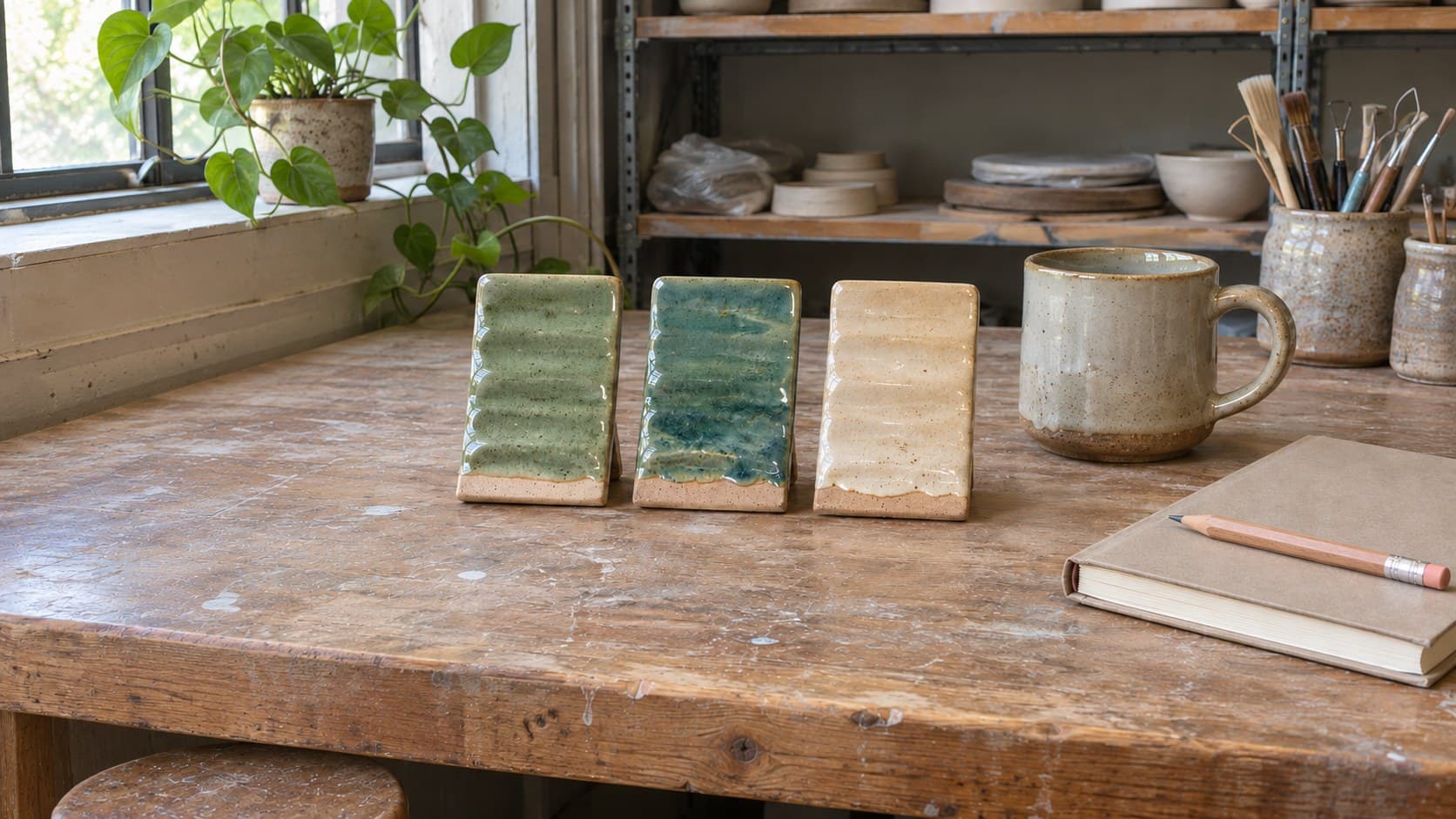
Record a steady view showing the tile’s full shape, glazed area, and unglazed foot. When comparing samples, place them together in the same shot first. This gives viewers a reference before the close-ups.
Use a quiet background. Move unrelated jars and colorful tools out of the comparison frame so the glaze remains easy to inspect on a phone screen.
Show the detail your conclusion depends on
If your point concerns texture, record the ridge and recessed area. If it concerns glaze movement, keep the relevant boundary visible. A beautiful close-up of another part of the tile is not evidence for the point you are explaining.
Take a static view and a gentle angle change. The angle change can help reveal reflection and surface character, but return to a stable view before asking viewers to compare two samples. Avoid filters or adjustments that deliberately exaggerate the difference.
Connect the surface to the record
Show the tile identifier or add it clearly during editing. Then display the short recipe in readable chunks. Speak the critical order aloud if the explanation relies on which glaze went on first.
Check the exported video at normal phone size. If someone must pause repeatedly just to decipher the essential recipe, simplify the screen and put supplementary notes in the caption. Essential context should not disappear behind a rapid transition.
Write a hook that promises the missing information
The opening should name the decision, not merely announce that the kiln is open. These are adaptable hook structures, not claims about a real test:
- “Here is the layering order behind this tile.”
- “These samples look different, but I changed more than one thing.”
- “Before copying this finish, check the clay body.”
- “The part of this glaze test I would repeat is the textured edge.”
Choose a line your footage can support. Do not promise a surprising reversal if your result is a subtle difference. A clear, modest finding is more useful than a dramatic headline followed by an ambiguous comparison.
If you want alternatives, the free hook generator can help you rephrase the same question. Keep the ceramic details in your own words and reject any suggestion that implies guaranteed results.
A hypothetical post from one documented test
Imagine a potter has two fired tiles from the same clay body, with the same two glazes applied in opposite orders. Their notebook contains the application and firing details. This is an illustrative production plan, not a reported experiment or customer result.
The opening frame shows both tiles together. The creator says they are comparing layering order. Next, each sample appears with its actual base and top glaze identified. A close-up shows the surface feature the creator is discussing, followed by the two tiles together again.
The conclusion stays narrow: the creator prefers one result for a future test on their intended form. They do not claim the preferred tile predicts every mug, every clay body, or every kiln load. The caption preserves the recorded conditions and invites a specific question about the comparison.
If the creator later discovers an undocumented difference between the tiles, that belongs in the explanation. Acknowledging the limitation makes the post more useful, not less complete.
Turn the unanswered question into your next post
Once the evidence is organized, choose the next editorial task: a clearer opening, a focused follow-up, or a different sample worth explaining. Do not start another broad montage simply because you have extra footage.
InsightTok AI can help with that planning layer. Its free account scan shows account statistics and a best-performing sound; the full Next Post Studio plan is part of the trial offering. Use the product to help select a niche-relevant sound, develop hook options, and choose a suggested posting window—not to invent technical conclusions about your ceramics.
Keep any music secondary to the explanation, and use only audio you have permission to use for the post. If a sound distracts from the glaze order or spoken caveat, a simpler audio choice serves this lesson better.
After publishing, read the actual questions. Repeated requests for the base glaze may mean your sequence was unclear. Questions about a different clay body suggest a new test rather than a stronger claim about the existing one. Views alone cannot establish that someone understood or successfully reproduced the recipe.
Your final pre-post check
Before sharing glaze test tile TikTok videos, confirm that each visible sample matches its record, the application order is unambiguous, and the conclusion stays within what you tested. Watch once without sound to check the labels, then listen without watching to check whether the explanation still makes sense.
Save the source footage and recipe together. That leaves you ready to answer a useful follow-up with evidence instead of memory.
When your test is documented and you want help shaping the next post, try InsightTok AI for a focused planning workflow.
InsightTok AI Team
Expert in TikTok growth strategies and social media analytics. Helping creators reach millions with data-driven insights and AI-powered recommendations.
Ready to Grow Your TikTok?
Get AI-powered analytics and content recommendations to boost your views and engagement.
Start Free TrialRelated Posts
Why TikTok Search Traffic Generates Clicks but Zero Sales: A 2026 Search-to-Conversion Audit
Discover why TikTok search views and clicks often fail to produce sales. This practical audit framework helps creators target buyer intent, qualify viewers, improve funnels, and measure revenue.

TikTok Cross-Posting in 2026: A Platform-Native Workflow for Reels, Shorts, and Facebook
Cross-posting does not automatically hurt TikTok reach, but recycled watermarks, compression, and generic edits can weaken performance. Learn how to create clean master assets and adapt each video efficiently for TikTok, Instagram, YouTube, and Facebook.

TikTok Voice Comments Strategy 2026: Turn Audio Replies Into Engagement and Sales
Learn how to use TikTok voice comments to answer objections, strengthen audience relationships, and drive measurable action. This guide includes a reply framework, realistic example, testing plan, and 30-minute routine.