
Key Takeaways
What you'll learn in this article
- Keep the camera, stance, lighting, and garment consistent so viewers can judge the alteration rather than the pose.
- Build one post around one fitting question, not a complete garment makeover.
- Show the starting fit, the specific intervention, and the same view afterward, followed by a comfortable movement check.
- Use viewer questions to choose the next demonstration; views alone cannot tell you whether the fitting explanation worked.
Key Takeaways
- Keep the camera, stance, lighting, and garment consistent so viewers can judge the alteration rather than the pose.
- Build one post around one fitting question, not a complete garment makeover.
- Show the starting fit, the specific intervention, and the same view afterward, followed by a comfortable movement check.
- Use viewer questions to choose the next demonstration; views alone cannot tell you whether the fitting explanation worked.
Useful sewing fit TikToks show whether an altered garment works in motion, not just whether it looks smoother in a reveal. Choose one everyday action relevant to the garment: sitting in trousers, reaching in a shirt, or walking in a skirt. Film the action and the return to a neutral stance, explain the fitting change, and distinguish visible fabric behavior from the wearer's report of comfort.
This is a filming and teaching workflow, not a universal fitting diagnosis. Similar-looking wrinkles can have different causes, and a garment that looks smooth while standing may still restrict sitting or reaching. Your job is to show the evidence and the limits of your example.
Choose one fitting question before recording
A full makeover often changes the shoulder, waist, sleeves, hem, and styling at once. That makes an attractive transformation but leaves a learner unable to identify which intervention produced which result.
Choose a smaller question you can demonstrate honestly:
- Did this adjustment reduce the excess fabric at this armhole?
- Does the waistband still gape when the wearer sits down?
- Did the sleeve change improve reaching without changing the intended silhouette?
- Does the hem hang differently when the wearer returns to a neutral stance?
Select a problem you can assess within your sewing expertise. If the cause is uncertain, frame the post as a fitting test rather than a definitive fix. Show what you tried and what remains unresolved.
For pants specifically, sewing instructor Melissa Mora recommends a test garment with properties similar to the final fabric and changing one thing at a time in her pants fitting guide. That is useful discipline for the video, too: isolate the intervention before turning it into advice.
Choose a movement that answers the fitting question
A generic before-and-after proves little about wearing the garment. Decide which ordinary action belongs in this specific lesson before you finalize the alteration. These are suggested demonstration choices, not standardized tests or universal fitting rules.
Waistbands and trousers: show sitting and standing
Use a stable chair and frame the waistband and upper legs without cropping away the relevant area. Record the wearer sitting comfortably, pausing, and standing again. Ask whether the waistband feels restrictive and whether the garment needs repositioning afterward.
Distinguish what the camera shows from what only the wearer can report. You can show a waistband changing position; you cannot establish comfort from its appearance alone. If someone else models, ask an open question about how the garment feels rather than prompting them to confirm it is better.
Sleeves and bodices: show a relevant reach
For an everyday shirt, a gentle forward reach may be more useful than an exaggerated overhead stretch. Choose an action consistent with how the garment will be worn. Keep the shoulder, armhole, and hem in view so the audience can see where movement is being accommodated.
Let the wearer return to neutral without pulling the garment down first. If it needs readjustment, show that. Explain that different designs have different intended movement ranges; do not judge a fitted formal garment and a loose work shirt by an identical silhouette standard.
Skirts and dresses: show an ordinary step
Record a short, comfortable walk with enough space to move safely. Keep the hem and relevant closure visible. Do not substitute a stationary spin if the lesson concerns walking room or how the garment settles after a step.
Use the same footwear when it affects the demonstration. Stop if a movement is uncomfortable; a tutorial does not need the wearer to strain to establish a point.
Record the return, not only the movement
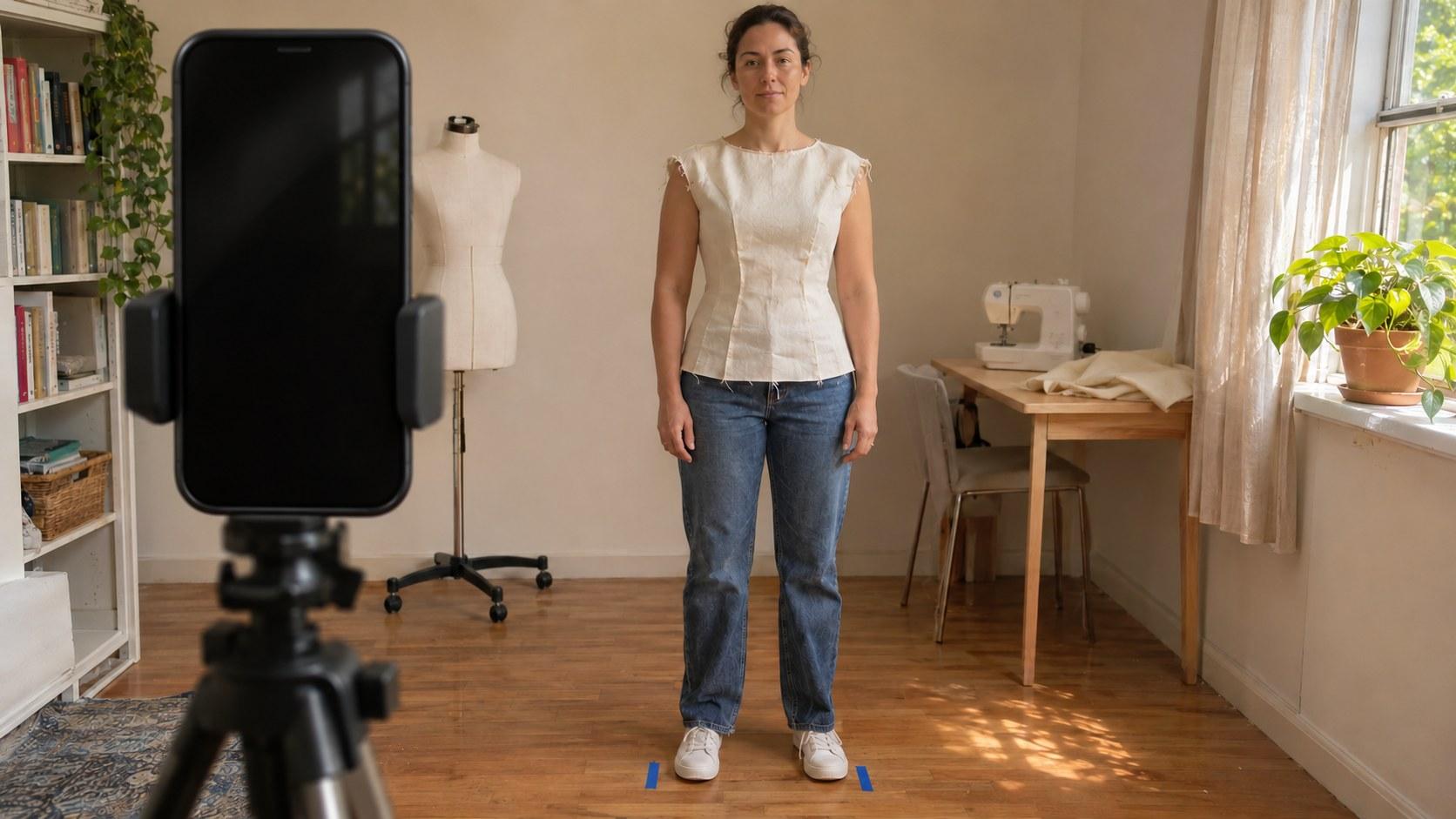
Hold the shot through the return to standing. That final moment shows whether the garment settles by itself or needs a tug. Keep the phone fixed, mark the standing position, and repeat the same framing for the next fitting stage. Do not change underlayers or styling without explaining it.
Record a sequence that preserves the evidence
You do not need a complicated edit. A useful sequence for sewing fit TikToks has five parts, each with a distinct job.
- Baseline: Show the garment in a neutral stance. Point out one visible issue without pulling the fabric into an exaggerated problem.
- Context: Name the garment type, relevant fabric properties, and what you are testing. Explain whether this is a toile, a basted fitting, or a finished garment alteration.
- Intervention: Show the actual seam, pattern, or fitting change. If you use pins to explore a change, distinguish that temporary test from the sewn result.
- Matched result: Return to the original camera position and stance. Give the viewer time to compare the same area.
- Movement: Show the action relevant to the garment, such as sitting, walking, or reaching, once it is safe to do so.
Remove exposed fitting pins before movement checks and use an appropriately secured test garment. Do not stage a convincing-looking result by holding fabric behind the wearer outside the frame. If a clip is pinned, label it as pinned.
A side-by-side edit can help, but only if both views are large enough to inspect on a phone. Alternating full-frame before and after clips may make a small fitting change easier to see. Match the scale rather than shrinking two full-body shots until the relevant seam disappears.
Do not confuse smoothness with usable fit
A wrinkle-free still image is not the only goal. In the same pants fitting guide, Mora notes that some wrinkles are expected and that movement requires room. Keep that distinction in your explanation rather than treating every fold as a defect.
Say what improved and what you checked. For example, a hypothetical educator might show that a waistband sits closer while standing, then discover it feels restrictive when seated. The honest next step is another fitting adjustment, not cutting away the seated clip.
Likewise, do not prescribe a measurement from your example as the amount every viewer should remove. Pattern shape, fabric behavior, body proportions, and intended ease differ. Explain the decision you made for this garment and encourage a test before altering valuable fabric.
Use neutral language about bodies. The garment is being adapted to a person; the person is not the problem to correct. If someone else is modeling, agree beforehand on the framing and footage they are comfortable publishing.
Write a hook that promises an observable answer
The opening should identify the fitting question, not announce that every viewer has been sewing incorrectly. Try one of these approaches, adapted to your actual demonstration:
- “This waistband looks fitted standing up. Here is the seated check.”
- “Same blouse, same stance: what changed after this adjustment?”
- “Before removing more fabric, watch what happens when I reach.”
These are sample hooks, not customer quotes or proven performance formulas. Each gives the viewer a specific comparison to watch for.
If you use the free hook generator, supply the garment, visible issue, and result you can genuinely show. Reject suggestions that promise a universal fix or a transformation the footage does not support.
Keep on-screen labels literal: before, temporary fitting test, sewn result, movement check. If you add measurements, state the units and whether the number refers to one side, total circumference, or a pattern adjustment. Correct captions so sewing terms remain understandable.
Turn the comparison into the next-post decision
After publishing, separate teaching feedback from distribution. Comments asking where you changed the seam suggest a different follow-up from comments asking whether the technique applies to stretch fabric. One needs a clearer intervention shot; the other needs a bounded demonstration in another material.
TikTok's Studio documentation describes account and video analytics, viewer activity times, and engagement insights. Use the tools available in your interface; do not assume every creator sees identical fields.
Review similar posts after the same observation period. Consider available viewing and engagement metrics alongside the substance of questions. A higher view count does not establish that the lesson was clearer, and a few comments are not a representative survey of everyone who watched.
InsightTok AI can help connect those observations to a focused next-post plan. Next Post Studio brings together hook ideas, niche-relevant rising sounds, and account-specific posting-time guidance. Use that planning support after choosing the fitting question, not as a replacement for deciding what your footage proves.
A sound is optional. If narration explains a subtle fitting decision, prioritize intelligibility over adding music. Similarly, treat a suggested posting window as a planning input, not a guarantee that this tutorial will reach the right learners.
Your pre-publication comparison check
Before exporting sewing fit TikToks, watch the matched clips with the narration muted and ask:
- Can I locate the same seam or fitting area in both views?
- Did the stance, crop, lighting, or styling change the apparent result?
- Is a pinned test clearly distinguished from a sewn alteration?
- Does the movement check support the claim made in the opening?
- Have I named the limits of this example without turning it into a universal prescription?
If the comparison is unclear, fix that before adding more effects. A trustworthy demonstration gives viewers something they can inspect, not merely a reveal they have to take on faith.
When you have chosen the next fitting question, try InsightTok AI to turn it into a focused post plan.
InsightTok AI Team
Expert in TikTok growth strategies and social media analytics. Helping creators reach millions with data-driven insights and AI-powered recommendations.
Ready to Grow Your TikTok?
Get AI-powered analytics and content recommendations to boost your views and engagement.
Start Free TrialRelated Posts
Why TikTok AI Search Summaries Can Steal Watch Time—and How Creators Can Recover Revenue in 2026
TikTok AI search summaries can increase visibility while reducing the views, profile visits, and clicks creators need to earn. Use the RECOVER framework to protect watch time, strengthen conversions, and build more resilient creator income.

How to Get Found by TikTok’s Creator AI Search in 2026
Discover how brands use AI-assisted creator search and what signals can make your TikTok account easier to identify. Follow a practical framework for profile positioning, content planning, analytics, and portfolio proof.
The TikTok Content Batching Blueprint 2026: Create a Month of Videos in 4 Hours
Learn how to plan, film, edit, and package a month of TikTok videos in one focused four-hour session. This practical blueprint helps creators stay consistent without sacrificing authenticity or burning out.