
Key Takeaways
What you'll learn in this article
- Build the video from a tested recipe, not from an attractive sequence of cooking clips.
- Keep ingredient quantities, preparation states, yield, and important cooking conditions consistent across the video and written recipe.
- Show the changes a cook needs to recognize, including texture, heat adjustments, and additions made off camera.
- Use viewer questions to choose the next recipe lesson, then assess understanding separately from views.
Key Takeaways
- Build the video from a tested recipe, not from an attractive sequence of cooking clips.
- Keep ingredient quantities, preparation states, yield, and important cooking conditions consistent across the video and written recipe.
- Show the changes a cook needs to recognize, including texture, heat adjustments, and additions made off camera.
- Use viewer questions to choose the next recipe lesson, then assess understanding separately from views.
To make TikTok recipe videos viewers can actually cook, start with a tested recipe and preserve its essential information through filming and editing: ingredients, quantities, sequence, equipment, cooking conditions, and the finished result. Cut repetitive footage, not the instructions that make the dish reproducible. A beautiful montage can inspire dinner; a useful recipe must also explain how to make it.
This guide is for food creators who receive questions about missing amounts, unexplained texture changes, or unclear cooking steps. The solution is not necessarily a longer video. It is a more reliable connection between what you cooked, what you filmed, and what your viewer can follow.
Decide whether you are sharing a recipe or inspiration
A meal idea and a recipe make different promises. A clip showing yesterday's lunch can be useful without exact measurements. A video promising that someone can make your cake needs the details that affect the result.
Name that promise before drafting your opening. If the post is a flexible assembly idea, say so. If it is a tested recipe, provide the full method somewhere viewers can reliably access, and keep the video understandable on its own at the key steps.
Do not intentionally hide essential quantities to generate comments. Questions caused by missing information are not the same as interest in another lesson.
Review a recent food post and sort its questions into three groups:
- Missing information: an amount, oven setting, pan size, or step was not provided.
- Technique: the instruction exists, but viewers cannot recognize the right consistency or movement.
- Variation: viewers want a substitution, different portion size, or alternative appliance.
Fix missing information first. Choose a technique question for a follow-up demonstration. Treat a variation as a new test rather than answering with an unsupported guess.
Make a recipe ledger before you film
Create one plain-text record that becomes the source for your script, overlays, and written recipe. You do not need special software; a note beside your filming setup is enough.
Record ingredients as they are actually used
For each ingredient, record its quantity, unit, preparation state, and point of use. “Chopped,” “drained,” “melted,” and “softened” can change what the viewer measures or does. Put those conditions beside the ingredient instead of burying them in a later comment.
Flag ingredients used in more than one step. If some oil goes into the pan and the rest goes into a dressing, identify both uses and check that they match the total listed amount. An unexplained second pour makes a recipe difficult to reproduce even when the first pour was perfectly captioned.
If you supply multiple measurement systems, verify the equivalents for the actual ingredient. Do not apply one generic cup-to-gram conversion across flour, liquids, and chopped vegetables. Include only conversions you can stand behind.
Record the conditions behind the result
Add the yield, relevant equipment size, starting preparation, heat or temperature settings, and any resting or cooling stage. Distinguish active cooking time from time spent waiting so the opening does not promise a speed the method cannot deliver.
Write down what changed during your test. Did you add extra liquid? Use a different pan? Extend a rest? Those adjustments belong in the tested version before you promote it as the recipe.
Also record observable cues: the mixture should coat a spoon, the dough should hold its shape, or the onions should reach the demonstrated stage. Use cues alongside necessary timings and temperatures, not as substitutes for food-safety instructions. For safety-critical directions, consult appropriate authoritative guidance rather than inferring safety from appearance.
Film the transitions that explain the dish
The most useful shots are often the ones between the glamorous beginning and finished plate. Capture the moments when the viewer must make a decision.
A practical filming sequence is:
- Show the finished dish and state what the recipe makes.
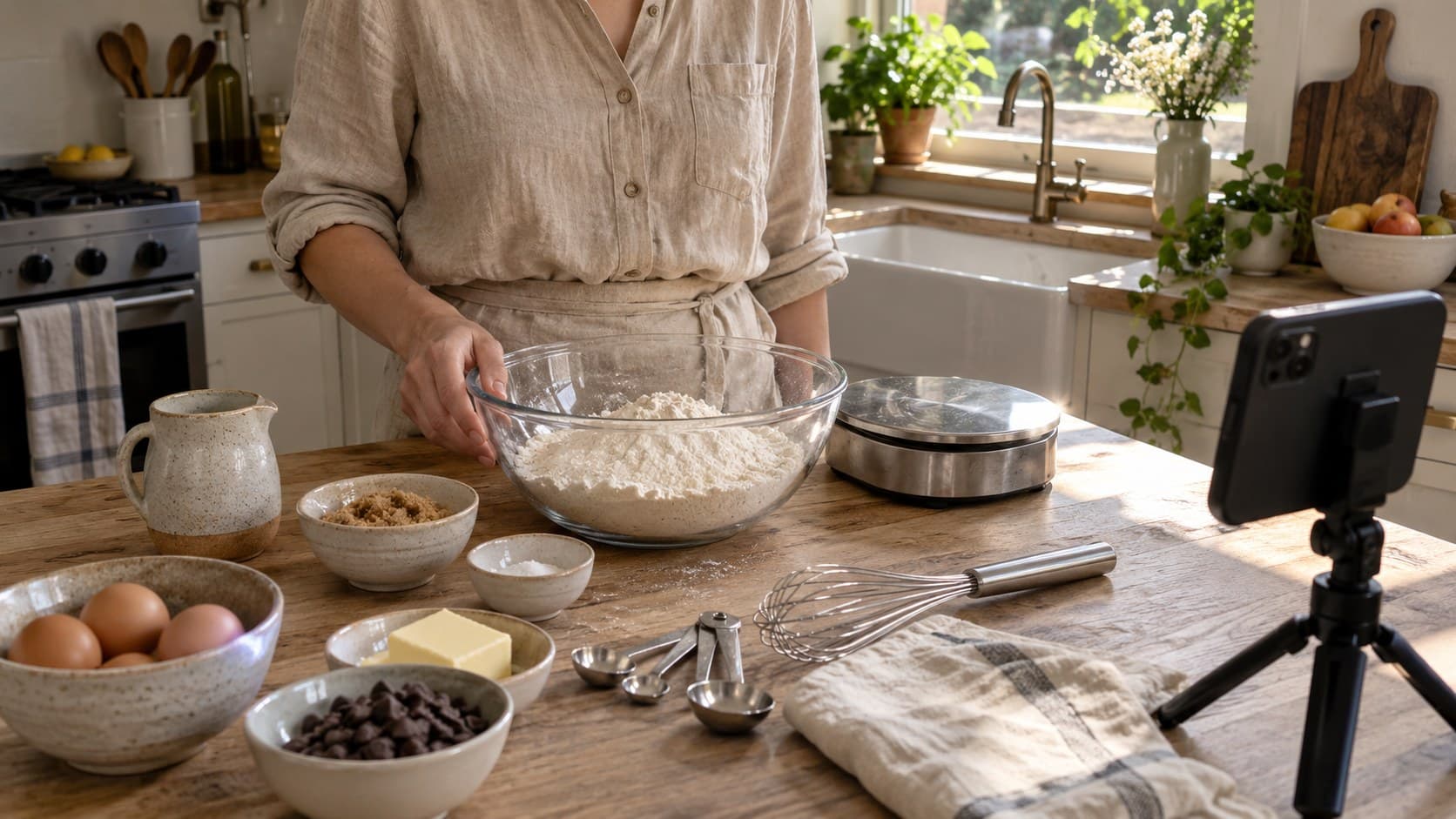
- Capture ingredients clearly enough to connect them with your written quantities.
- Show important preparation states before combining ingredients.
- Record each addition that materially changes the mixture.
- Film a close view of the key texture or cooking transition.
- Show the final result at the same stage you tell viewers to serve it.
You can still open with a satisfying cut, pour, or spoonful. Just make sure the opening result comes from the recipe you are teaching, not a separate batch prepared differently for the camera.
Label meaningful time jumps. A cut from loose mixture to thick sauce should not imply that the change was immediate if it required a cooking or resting stage. Likewise, do not hide an off-camera addition simply because the pouring shot was missed. Explain it accurately in the narration or text.
Avoid balancing a phone precariously over hot equipment to rescue a shot. Capture a safe alternative view and prioritize a clear explanation over an elaborate camera move.
Reconcile the edit with the written recipe
Good TikTok recipe videos have an information check as well as a visual check. Watch the finished edit with the ledger open and track every ingredient from list to final dish.
Ask:
- Does every listed ingredient appear in the method?
- Does every visible addition appear in the ingredient list?
- Are split-use ingredients explained consistently?
- Do the stated yield, equipment, and cooking conditions match the filmed batch?
- Have captions changed a unit, number, ingredient name, or important instruction?
- Is the written version the same tested version as the video?
TikTok's current TikTok Studio documentation describes tools for adding and editing auto captions. Review generated captions manually, especially amounts and units. Available tools vary across interfaces; use the controls your account provides rather than assuming a particular editing screen.
Keep step labels and subtitles from obscuring the mixture or measuring action. Pause the exported video on a phone and check whether a viewer can read the information without guessing. There is no value in including a complete instruction if it disappears before someone can understand it.
A separate written recipe is useful for shopping and cooking, but it should not excuse an edit that omits its central instruction. Tell viewers clearly where the complete recipe is available, and verify that destination before posting.
A hypothetical repair: the unexplained sauce change
Imagine a food creator whose pasta video jumps from a thick sauce to a glossy finished dish. Viewers ask what happened between those shots. This is an illustrative editing problem, not a real account or reported result.
During filming, the creator added reserved cooking liquid, but the addition never appeared in the edit or written method. The next post should demonstrate that missing transition, using a tested amount and an explanation of the desired consistency.
The brief becomes specific: show when the liquid is added, how it is incorporated, and what the mixture looks like before and after. The creator updates the written method to match the tested process rather than inventing an amount from memory.
A useful opening would name the actual lesson: “Here is the missing step between the thick sauce and the finished pasta.” It does not need a claim about a secret restaurant technique or guaranteed results.
This repair solves a cooking problem. A generic sequel featuring the same plated dish would leave the original question unanswered.
Turn the verified recipe into a next-post plan
Once the lesson is accurate, package it around the viewer's problem. If you need opening alternatives, the free hook generator can help draft them. Reject any wording that invents a cooking time, health benefit, or result the recipe does not support.
InsightTok AI can help organize that packaging through Next Post Studio: hook options, a niche-relevant rising sound, and an account-specific posting-time recommendation. Start with the public account scan, then build the plan around the tested dish or technique rather than choosing a recipe solely to fit a sound.
For narrated cooking, music should not compete with quantities or instructions. A rising sound is optional. A complete method is not. Treat the suggested posting window as a planning input, not a promise that a particular dish will reach more people.
InsightTok AI helps plan and review the post; it does not test recipes, validate substitutions, or certify food-safety claims. Keep those responsibilities with the creator and suitable authoritative sources.
Check whether viewers can use what you posted
When reviewing TikTok recipe videos, separate attention from usefulness. A view does not prove someone cooked the dish, and a save does not prove the recipe worked.
TikTok Studio documents account and video analytics, including viewer activity and engagement insights. Use your available metrics alongside the substance of comments. Compare reasonably similar posts over the same observation period rather than comparing a fresh tutorial with an older video's lifetime totals.
Look for unresolved instructions, not just praise. Are viewers still asking about the missing addition? Are new questions about a genuinely different variation? If someone reports a failed result, ask about the relevant conditions before assuming they ignored the recipe.
Before publishing today, check the ledger, reconcile every addition, review captions, and watch the key transition once more. Your next post can be a better recipe without becoming a more complicated production.
When the recipe is ready, create your next-post plan to organize the hook, sound choice, and posting window around a lesson viewers can use.
InsightTok AI Team
Expert in TikTok growth strategies and social media analytics. Helping creators reach millions with data-driven insights and AI-powered recommendations.
Ready to Grow Your TikTok?
Get AI-powered analytics and content recommendations to boost your views and engagement.
Start Free TrialRelated Posts
Why Your Faceless TikTok Channel Earns Half What You Expected: The Three-Part Asset Framework to Turn Screen Recordings Into $400-$1500+ Monthly Recurring Revenue Through Discovery, Retention, and Conversion Signals in 2026
This article introduces a unique three-part asset framework to help faceless TikTok creators to monetize their screen recordings effectively in 2026.
Why Your One-Off Brand Deals Are Dying in 2026: The Custom Creator Network Framework
Custom Creator Networks are reshaping the future of TikTok monetization. Discover how you can secure stable, recurring income through long-term brand partnerships and AI.
Why Your Founder-Mode Vulnerability Videos Get 2M+ Views But Zero Product Sales: The Authenticity-to-Revenue Framework to Turn Raw Founder Moments Into Recurring $800-$2400+ Monthly From Direct-to-Customer Conversions in 2026
Discover why your founder-mode TikTok videos are getting millions of views but zero product sales, and learn how to turn this around with the Authenticity-to-Revenue Framework.