
Key Takeaways
What you'll learn in this article
- Turn one original-hardware decision into a complete post instead of waiting for the finished furniture reveal.
- Show condition, mounting fit, and design preference as separate questions; attractive hardware is not automatically suitable hardware.
- Record the original placement and keep removed parts organized before filming alternatives.
- End with the decision you can support today, including what still needs checking.
- Use audience questions and comparable post analytics to choose the next lesson, not to declare a universal winning format.
Key Takeaways
- Turn one original-hardware decision into a complete post instead of waiting for the finished furniture reveal.
- Show condition, mounting fit, and design preference as separate questions; attractive hardware is not automatically suitable hardware.
- Record the original placement and keep removed parts organized before filming alternatives.
- End with the decision you can support today, including what still needs checking.
- Use audience questions and comparable post analytics to choose the next lesson, not to declare a universal winning format.
Useful furniture restoration TikToks can explain why you are keeping or replacing the original drawer pulls. Show the original hardware on the piece, document the relevant condition and mounting constraints, compare a realistic alternative, and explain your decision. You do not need a completed dresser or a dramatic transformation to give viewers a satisfying answer.
This guide is for restoration and furniture-flipping creators who have a project underway but no finished reveal ready to publish. It is a content-planning workflow, not a conservation manual or a recommendation to strip, polish, or modify antique hardware. The goal is to make your judgment visible without pretending every old piece needs the same treatment.
Choose a decision that actually exists
Start with the question you are already trying to answer in the workshop. Perhaps one pull is missing, an existing handle is uncomfortable to use, or the replacement you like would require changing the drawer front. That tension is enough for a post.
Avoid manufacturing a dilemma after the work is finished. If you already decided to preserve the originals, explain what settled the choice rather than staging a misleading audience vote. If the choice is genuinely open, state the constraint that makes it difficult.
Write a one-sentence brief before recording:
“I am deciding whether to keep these original pulls because the replacement changes more than the appearance.”
Then specify what that means for this piece. A real mounting mismatch is stronger evidence than a vague claim that vintage is always better. Equally, replacement can be reasonable without making the original hardware worthless. Your job is to explain the tradeoff, not defend a universal decorating rule.
Record the original state before removing anything
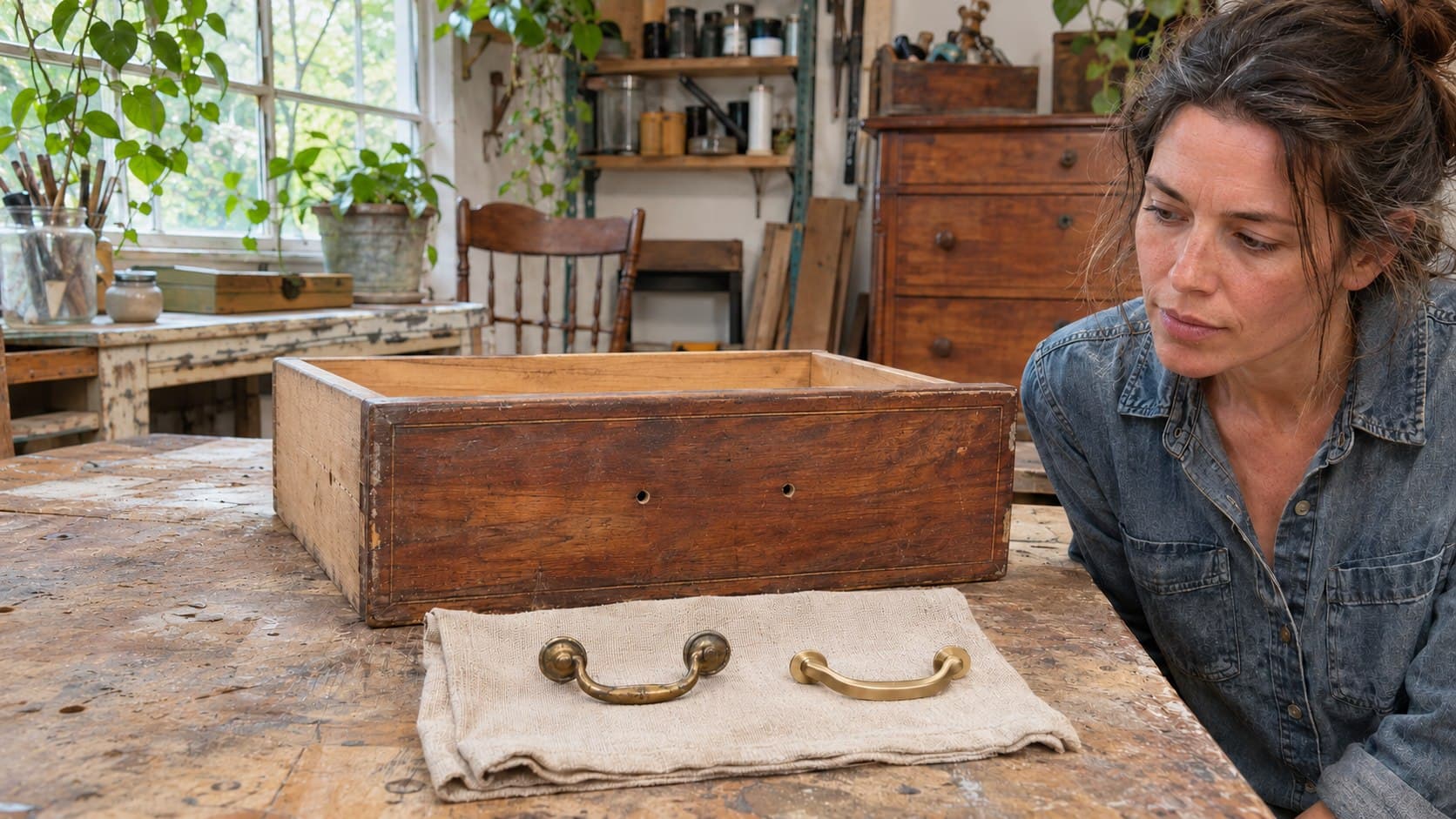
Capture a wide view of the furniture and a closer view of the relevant drawer. Show how the hardware relates to the surrounding shape, finish, and other pulls. A close-up of a loose handle on a bench cannot establish how it looks on the piece.
If you remove hardware as part of your normal work, photograph its position first and keep the parts grouped by location. Put small components in a stable container away from the edge of the bench. Do not dismantle a delicate or unfamiliar mechanism merely to make a more interesting shot.
Record these details while they are still available:
- The original pull in its actual position.
- Any visible missing, loose, or damaged component relevant to the decision.
- The mounting arrangement, if safely accessible.
- The surrounding finish, including any visible outline the existing hardware leaves.
- The proposed alternative, clearly identified as an option rather than an installed solution.
For valuable or potentially historic furniture, get appropriate specialist advice before irreversible changes. The useful video may be about pausing for identification, not about demonstrating an aggressive cleaning method.
Separate condition, fit, and preference
The middle of the post should answer three different questions. Keeping them separate makes the reasoning easier to follow and prevents a style preference from sounding like a technical diagnosis.
Condition: what do you actually know?
Describe what the footage shows. “One pull is missing” is an observation. “This dark surface means the metal is ruined” is a conclusion you may not be qualified to make.
Do not assume the material or finish from color alone. If identification matters to the next step, explain that uncertainty. Avoid turning the video into a cleaning recipe unless you can support the method for that particular material and finish.
Fit: what would changing it require?
Show the relevant mounting points and the alternative's arrangement. If you measure spacing, film the measurement clearly and use consistent units. Do not present an approximate visual match as confirmed compatibility.
Explain any additional work that your actual comparison reveals. Would the alternative leave an existing mark visible? Would installation require new holes? Have you checked the mounting hardware, or are you only comparing the front appearance? These are distinct stages of the decision.
Preference: which look serves this project?
Now explain your design choice. You might prefer the original shape, want consistency across several drawers, or be working within a client's brief. Name that preference as a preference.
You can invite viewers to describe their priorities without handing over responsibility for the work. “Would you prioritize matching the other drawers or changing the style?” gives people context. “Pick one and I will drill tomorrow” can create pressure to act before checking suitability.
Build a five-shot story with a real ending
For furniture restoration TikToks about hardware, use the decision itself as the narrative. The following sequence is a practical editing suggestion, not a TikTok ranking formula.
- Establish the piece. Show the drawer with its original pull and name the specific question.
- Reveal the constraint. Move close enough to show the missing part, mounting issue, or other detail behind the decision.
- Introduce the alternative. Place the candidate nearby or show a safe temporary comparison. Say when it is not installed.
- Explain the tradeoff. Connect the visible evidence to the extra work, uncertainty, or design consequence.
- State the current decision. Keep, replace, investigate, or postpone—with a reason.
A complete ending does not require a completed restoration. “I am keeping these while I look for a matching missing pull” resolves today's question. “I cannot confirm this replacement fits yet” is also an honest outcome if the post explains what remains to check.
Do not hide the important constraint under rapid transitions. Give viewers enough time to locate the mounting points or recognize the original shape. Review the draft on a phone, where the small detail must still be legible.
Write a hook your footage can prove
Use a specific decision rather than a promise that the whole project will shock viewers. These are original script options, not quotations from creators:
- “The new handles look right, but here is what I still need to check.”
- “I nearly replaced these pulls before looking at the drawer front.”
- “One missing handle changed the plan for this dresser.”
Choose only an opening that matches what actually happened. If the replacement fits, do not invent a mounting problem to justify the second line.
The hook generator can help explore variations, but the visible evidence should constrain the wording. Make the first shot identify the furniture and the question; an unrelated attractive workshop montage delays the explanation.
A hypothetical next-post brief
Imagine a creator restoring a small dresser with one missing original pull. This is an illustrative production plan, not a customer result.
The intended audience is people deciding whether to preserve original details on their own furniture. The lesson is that replacing a full set involves both design and practical checks, not just choosing the nicest handle online.
The creator records the complete drawers, the drawer missing its pull, and a candidate replacement beside the existing hardware. They explain that compatibility is still unconfirmed and that they will first investigate a matching replacement for the missing original. The ending gives a clear next action without suggesting the search has already succeeded.
That brief supports a later follow-up if a suitable match is found. It does not require an artificial cliffhanger: today's post already explains why the creator paused.
Package the lesson without letting a trend replace it
Once the decision story works, choose its hook, audio, and publishing window. InsightTok AI's Next Post Studio helps turn an account-informed idea into a next-post plan with useful hooks, a niche-relevant rising sound, and a suggested posting time.
Treat those suggestions as inputs rather than instructions to distort the lesson. Keep narration intelligible. Original workshop sound may be enough; a music transition should not cut away from the detail viewers need to inspect. Use audio you have permission to use for the post's purpose.
You can review the broader planning tools on the InsightTok AI homepage. The practical benefit here is having a focused post ready while the larger restoration continues, not a promise that a particular sound or time will increase reach.
Let the response choose the next useful question
TikTok's current TikTok Studio documentation describes account and video analytics, viewer activity times, and engagement insights including comment insights and inspiration for future posts. Use the features available in your interface; access and tools can vary.
Compare the post with your other short decision explanations after the same observation period. A hardware discussion and a full-room reveal serve different purposes, so their raw view counts are not a clean test of which format is better.
Read the questions behind the engagement. Repeated confusion about which pull is original suggests the comparison needs clearer labeling. Questions about finding a matching missing part suggest a possible sourcing follow-up. Preference comments alone do not establish that a replacement will fit or that you should alter the furniture.
Before recording more furniture restoration TikToks, finish this brief: one real decision, one visible constraint, one supported conclusion, and one next question. When you want help turning that brief into a publishing plan, start with Next Post Studio.
InsightTok AI Team
Expert in TikTok growth strategies and social media analytics. Helping creators reach millions with data-driven insights and AI-powered recommendations.
Ready to Grow Your TikTok?
Get AI-powered analytics and content recommendations to boost your views and engagement.
Start Free TrialRelated Posts

Glaze Test Tile TikTok Videos: Show the Recipe, Not Just the Reveal
Make glaze test tile TikTok videos with clear layering order, clay and firing notes, and an honest recipe viewers can understand and test.

Why TikTok Search Traffic Generates Clicks but Zero Sales: A 2026 Search-to-Conversion Audit
Discover why TikTok search views and clicks often fail to produce sales. This practical audit framework helps creators target buyer intent, qualify viewers, improve funnels, and measure revenue.

TikTok Cross-Posting in 2026: A Platform-Native Workflow for Reels, Shorts, and Facebook
Cross-posting does not automatically hurt TikTok reach, but recycled watermarks, compression, and generic edits can weaken performance. Learn how to create clean master assets and adapt each video efficiently for TikTok, Instagram, YouTube, and Facebook.