
Key Takeaways
What you'll learn in this article
- Make a left-handed companion lesson for one specific crochet task, rather than flipping an entire project without checking it.
- Decide whether to film a practiced left-handed demonstration or adapt clean footage, then verify the actual technique with a left-handed crocheter.
- Review hand roles, pattern direction, charts, narration, and text separately; a horizontal flip changes pixels, not instructions.
- Test the finished lesson at phone size before building a hook, sound choice, and publishing plan around it.
Key Takeaways
- Make a left-handed companion lesson for one specific crochet task, rather than flipping an entire project without checking it.
- Decide whether to film a practiced left-handed demonstration or adapt clean footage, then verify the actual technique with a left-handed crocheter.
- Review hand roles, pattern direction, charts, narration, and text separately; a horizontal flip changes pixels, not instructions.
- Test the finished lesson at phone size before building a hook, sound choice, and publishing plan around it.
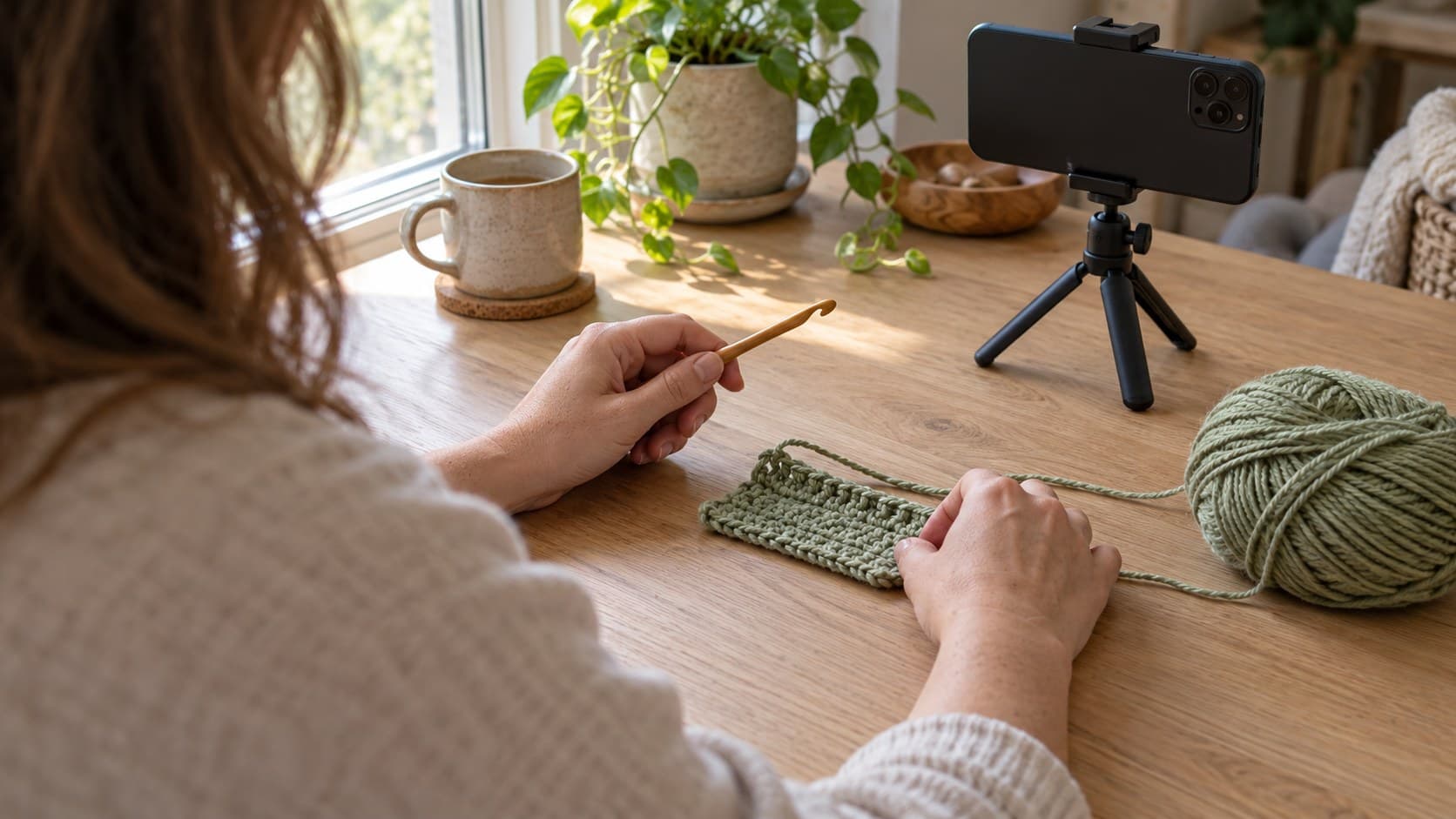
To make useful left-handed crochet TikToks, choose one small technique, show the hook in the left hand and the supporting yarn work in the right, and check that the demonstration, directions, and finished result agree. You can film a practiced left-handed demonstration or intentionally mirror suitable clean footage. Neither approach is ready to publish until someone can follow the resulting lesson without mentally correcting your instructions.
This guide is for crochet creators responding to requests for a left-handed version. It is not a guide to fixing accidental camera mirroring, and it does not claim that an adapted tutorial receives special treatment from TikTok. The goal is a companion post that serves a learner your original demonstration did not serve well.
Choose one task worth adapting
Start with a concrete request from your own audience, if you have one. Separate “I need a left-handed version” from “I cannot see where the hook goes.” The first may need an adaptation; the second may need a better close-up regardless of handedness.
Pick a task small enough to verify completely:
- Forming the starting chain.
- Inserting the hook into the intended part of a stitch.
- Showing a particular yarn movement.
- Recognizing the beginning or end of a row.
Avoid making an entire garment your first adaptation. A short stitch demonstration has fewer directional dependencies than shaping, joining, button placement, and chart reading across a full project.
Write the audience and boundary before recording: “For someone holding the hook in their left hand who already has a starting loop, show the next chain movement.” That is a clearer brief than “crochet for lefties.” Do not imply that every left-handed person uses the same grip or must change how they already crochet comfortably.
Understand what changes beyond the picture
Annie's guide for left-handed crocheters describes holding the hook in the left hand and manipulating the yarn with the right. It also discusses different hook holds, changes in working direction, and the need to interpret directional patterns and charts carefully.
That distinction matters for video production. Swapping the apparent hand position may be enough to illustrate some simple movements, but it does not automatically validate a whole pattern adaptation.
Check these layers separately:
- Hand roles: Which hand holds the hook, supports the work, and controls the yarn?
- Movement: Can the learner reproduce the demonstrated action with the intended setup?
- Pattern direction: Does the lesson depend on a particular edge, chart direction, or asymmetric result?
- Language: Do spoken and written directions still describe what the learner should do?
- Evidence: Does the finished sample actually demonstrate the promised outcome?
For lettering, shaped pieces, or a directional chart, verify the pattern itself with a knowledgeable crocheter or its designer. Do not treat a flipped picture as proof that the finished project will face the intended way. Stay with a simpler lesson if you cannot verify the adaptation today.
Choose between filming and mirroring
Film a left-handed demonstration when you can teach it reliably
A genuine left-handed demonstration makes it easier to keep physical labels, tools, and narration consistent. But being fluent right-handed does not automatically make your first left-handed attempt suitable instruction.
Practice the exact movement before recording. If your technique is uncertain, collaborate with a left-handed crocheter who can demonstrate it and agree on how their work will be credited and used. Do not coach an awkward or unreliable movement just to complete the post.
Use a stable camera angle from the learner's side of the work when practical. Keep enough context to identify both hand roles, then move closer only where the contact point needs more detail. A beautiful close-up is unhelpful if viewers cannot tell how to hold the starting work.
Mirror clean footage only when the adapted technique checks out
A horizontal flip can be a production tool for an intentional companion lesson. It is not a substitute for reviewing the craft instructions.
Apple's current Photos editing guide documents horizontal flipping for photos and videos, separately from rotation. On an iPhone, work from a preserved original, open the clip's editing and crop controls, use the horizontal flip control, and inspect the saved result. Interface details can vary by software version.
Use footage you own or have permission to adapt. Begin with a clean source that does not already contain burned-in captions or instructional arrows. If you only have a finished export, returning to the editable project is usually clearer than covering reversed text with another layer.
Rebuild the instructions around hand roles
For left-handed crochet TikToks, write a small adaptation sheet before editing. Include the task, the starting state, the hand holding the hook, the hand supporting the yarn, and the visible success check.
Replace vague wording with an instruction tied to the object or role. “The hand holding the hook” can be more stable than “this hand.” “The loop already on the hook” is more specific than “the bit on the left.” These are wording examples, not a replacement for correct stitch instruction.
Do not remove useful directional words everywhere. When left or right genuinely matters, specify whether you mean the learner's hand, an edge of the work, or a position on the screen. Keep that convention consistent through the lesson.
Record the voiceover after checking the final orientation. A horizontal flip cannot change a spoken “right hand” into “left hand.” Likewise, an arrow that was correct before the flip may now point to the wrong loop or edge.
Keep footage and text on separate tracks
Treat the adaptation as several editorial decisions, not one whole-video effect:
- Preserve the original source and create a clearly named working copy.
- Flip only the intended demonstration clips, if that is your chosen method.
- Review physical writing, numbered markers, and directional references within those clips.
- Add readable titles and step labels after the footage orientation is settled.
- Record or revise narration, then check the transcript against the audio.
- Export and watch the actual saved file, not only the timeline preview.
If a physical label becomes backward, do not simply ignore it because your digital caption is readable. Reframe or re-record where appropriate, without hiding information the learner needs. Never reverse a chart or written pattern indiscriminately to make it match the video.
Label the companion clearly, such as “Left-handed starting chain.” If the demonstration is mirrored, a brief description can say so. Clear labeling helps viewers choose the version they need without promising that one technique fits every learner.
Test one complete movement with a learner
Ask a left-handed crocheter to review the technique. Where possible, also ask a learner at the intended level to follow the finished draft using the stated materials and starting setup. Technical accuracy and beginner usability are related but different checks.
Do not explain over the video while they watch. Observe where they pause, swap hands, lose their place, or ask which strand you mean. Then ask:
- Could you match the starting position?
- Which movement required extra explanation?
- Did the narration agree with the hand positions?
- Could you recognize the result without being told it was correct?
Fix the earliest obstacle and replay that section. If no reviewer is available, you can audit the draft yourself, but do not present that as independent validation. Hold an uncertain instructional claim until someone qualified can check it.
A hypothetical starting-chain companion
Imagine a creator has a useful right-handed chain lesson and receives requests for another orientation. This is an illustrative workflow, not a customer case study.
The creator chooses only the chain movement, preserves the original footage, and makes a mirrored working copy. They remove the old text track, rewrite a spoken hand reference, and add a new readable opening label. A left-handed reviewer checks the movement, while a beginner tests whether the starting loop and yarn roles are clear.
If the beginner cannot locate the starting loop, the creator adds a setup shot rather than slowing every clip. If the movement itself is wrong, they re-record it. The finished companion delivers one complete lesson without pretending to adapt an entire pattern.
Turn the verified lesson into your next post
Once the lesson works, package its actual benefit. Try an opening such as “Holding the hook in your left hand? Start with this chain movement.” Avoid a broad promise to make every crochet pattern easy.
The free hook generator can help explore alternate wording. Choose a line that matches the footage rather than adding urgency the lesson does not need.
InsightTok AI can support the surrounding plan through Next Post Studio: hook options, a niche-relevant rising sound, and personalized posting-time guidance. Use those suggestions after choosing the verified technique. Keep music subordinate to instruction, and treat the proposed publishing window as a planning aid rather than a guarantee of results.
Save the adaptation sheet beside your source clips. For future left-handed crochet TikToks, it becomes a record of what you checked, not permission to reuse the same flip on every project. New charts, tools, and directional instructions deserve a fresh review.
Before uploading, confirm that the hand roles are consistent, every text layer reads correctly, the narration matches the footage, and the ending shows the promised result. When you want help turning that checked lesson into a focused publishing plan, try InsightTok AI.
InsightTok AI Team
Expert in TikTok growth strategies and social media analytics. Helping creators reach millions with data-driven insights and AI-powered recommendations.
Ready to Grow Your TikTok?
Get AI-powered analytics and content recommendations to boost your views and engagement.
Start Free TrialRelated Posts
How to Plan TikTok Videos for Projects That Take Several Days
A practical filming and publishing workflow for multi-session projects: capture meaningful milestones, preserve session notes, and choose an honest standalone lesson or complete recap.
Why Your TikTok LIVE Sessions Generate 10K+ Viewers But Your Monthly Income Stays Flat: The LIVE-to-Evergreen Asset Monetization Framework
Have you ever wondered why your TikTok LIVE sessions attract thousands of viewers but your monthly income remains stagnant? Many creators face this challenge.
Why Your TikTok Reach Collapses After a 2-Week Hiatus But Never Fully Recovers: The Posting-Consistency Penalty Recovery Framework
Understand the harsh reality of the TikTok hiatus algorithm penalty and how to restore lost revenue with InsightTok AI's recovery framework.