
Key Takeaways
What you'll learn in this article
- Show the paper's condition before the brush touches it, not just the finished soft edge.
- Keep the first stroke and its spreading pigment in one continuous, normal-speed shot.
- Explain waiting periods and brush preparation instead of hiding them in a fast edit.
- Build the next lesson around one unresolved painting decision, then choose its hook, sound, and posting window.
Key Takeaways
- Show the paper's condition before the brush touches it, not just the finished soft edge.
- Keep the first stroke and its spreading pigment in one continuous, normal-speed shot.
- Explain waiting periods and brush preparation instead of hiding them in a fast edit.
- Build the next lesson around one unresolved painting decision, then choose its hook, sound, and posting window.
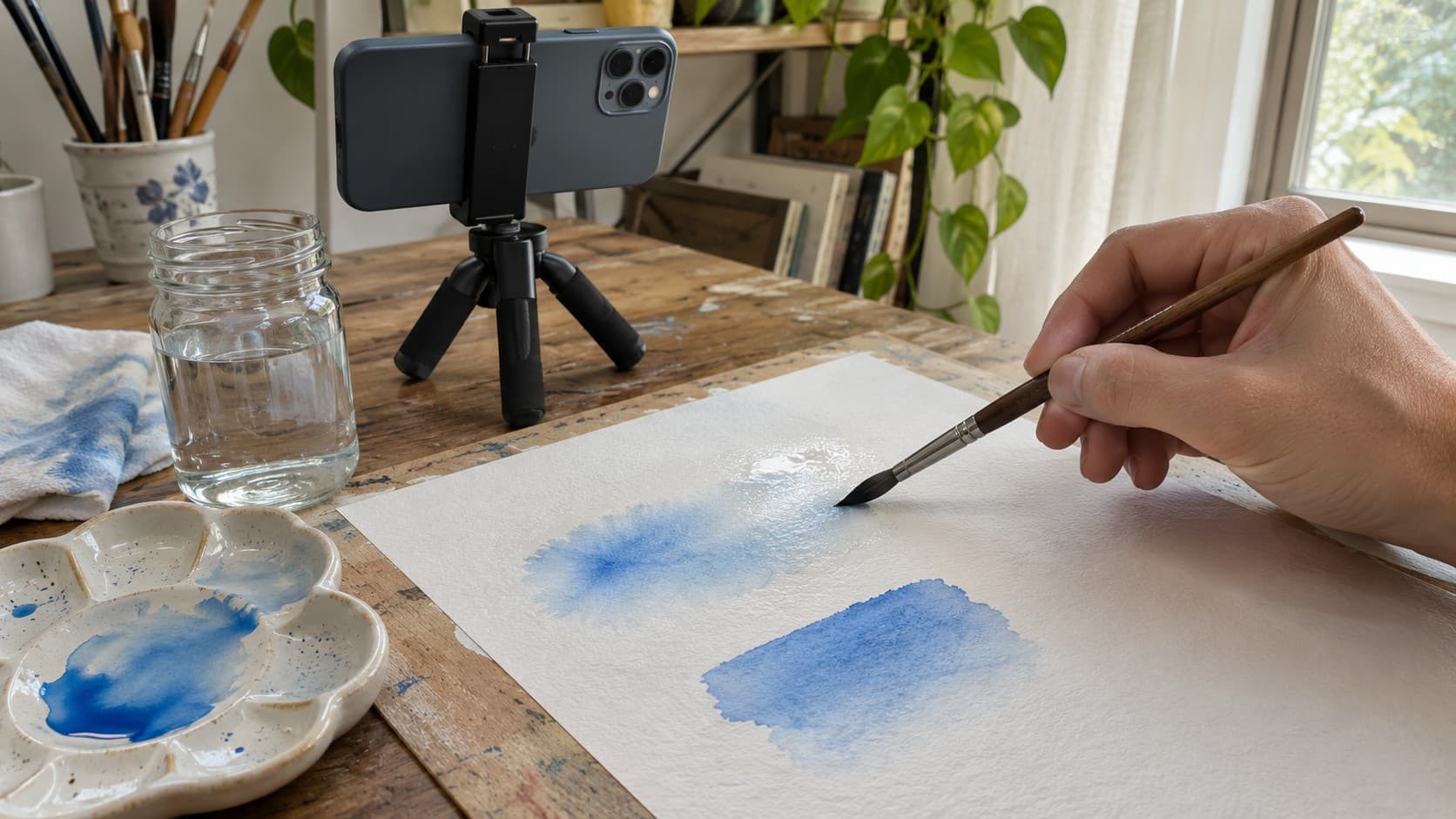
Useful watercolor TikTok tutorials show when to make a mark, not only where to put it. To explain a soft edge, film the paper before the brushstroke, describe its visible moisture, and keep recording as the pigment moves. Pair that close-up with a brief explanation of your brush preparation. The viewer should understand the condition you painted into, rather than trying to copy a finished shape from a montage.
This is especially useful when viewers say their version looks sharper, spreads farther, or behaves differently from yours. Those comments do not establish the cause. They do identify a missing teaching opportunity: the preparation between wetting the paper and applying color.
Choose one edge question for the next post
Instead of filming an entire landscape, select one decision: “When do I add this soft cloud edge?” A small practice wash gives you enough room to answer without requiring a complete painting lesson.
Winsor & Newton's wet-on-wet guide describes applying diluted watercolor to wet or damp paper to produce smooth washes without harsh, defined edges. It also encourages experimenting with different colors and papers. That supports the technique, not a universal waiting time or a promise that every combination behaves identically.
Your post can therefore explain one observed result on your materials. Name the paper and paint you actually use. Do not claim that a shiny surface always produces a specific edge, or that a fixed number of seconds works in every studio.
Keep other lessons separate. Correcting a bloom, choosing paper, and layering a dry wash may all deserve posts, but they should not compete with the decision your opening promises to answer.
Make the paper's condition visible
Clear water can disappear in a straight-down view. Before applying paint, check whether your filming angle shows the surface sheen without washing out the whole sheet.
A small change in the light or camera angle may reveal the damp area. Record this establishing view, then settle into the angle that best shows the brush and pigment. Tell viewers if you change angles; do not make two different patches look like one uninterrupted test.
Describe what you observe in ordinary language:
- Where water was applied on this sheet.
- Whether you can see pooled water or a more even sheen.
- Whether the surface has changed while you were setting up.
- What you are looking for before making the mark.
Treat those descriptions as observations, not remote moisture measurements. A viewer's screen, your lighting, and the paper surface all affect what is visible. If the camera cannot show a subtle change, say what you are judging rather than increasing contrast until the paper appears dramatically different.
Set up the phone before wetting the practice area. Otherwise, the important condition may change while you adjust the frame. Keep the tripod clear of the water jar and your painting arm, and make a quick rehearsal with a dry brush.
Include the brush preparation
Paper is only half of what the viewer sees. A jump from a dry brush to a loaded brush hides another practical decision.
Record how you pick up the diluted color and any normal step you take to remove excess liquid. You do not need a long close-up of the palette. You do need an honest explanation of what enters the shot.
For example, explain that you loaded the brush from the same mixture used in the demonstration and touched it to a towel if that is what actually happened. Avoid prescribing a universal number of taps or wipes. Brush size, mixture, and materials differ.
If you compare two marks, try to keep the paper, pigment mixture, brush, and stroke similar. Note any meaningful difference you cannot control. This is an instructional comparison, not a laboratory experiment isolating every variable.
Never quietly reload with a much stronger mixture to make the second result more dramatic. That may create an interesting image, but it makes the moisture lesson harder to interpret.
Keep contact and pigment movement together
The most useful footage in watercolor TikTok tutorials is often the short interval immediately after brush contact. Keep that section continuous and at normal speed.
Start recording before the brush enters. Leave enough room around the mark to show its boundary. Continue after the brush lifts so viewers can observe what happens next, rather than cutting immediately to a finished wash.
Watch for three common filming failures:
- Your hand blocks the edge you are discussing.
- The focus shifts to the brush handle while the paper becomes soft.
- A tight crop removes the spreading boundary from the frame.
Check a rehearsal on the phone before recording the full explanation. If your hand naturally blocks the view, change the camera position rather than demonstrating an awkward painting grip for the lens.
Narration can come later. Recording the real movement first lets you describe what happened instead of rushing the technique to finish a sentence. Keep the original clip so you can check that your edited explanation matches it.
Preserve waiting without making viewers watch it all
You can shorten a waiting period without hiding it. Use an explicit transition such as “after the surface changed” or “later, on the same practice area.” If you give an elapsed time, identify it as the timing of this demonstration, not a rule for another person's paper.
A useful edit has three parts: the initial condition, an acknowledged wait, and the condition immediately before painting. It does not need to show every second between them.
If you use separate practice patches, label them as separate patches. Do not cut from one wet area to a different prepared area while implying that the same water dried instantly.
Likewise, do not speed up pigment spreading and then describe that speed as the natural behavior. If you include a time-lapse for context, distinguish it from the normal-speed evidence shot. The teaching moment should remain easy to find without repeated pausing.
Write a hook that names the missing decision
A strong opening can be specific without promising a secret. Try structures like these, adapting them to your actual footage:
- “Before this soft edge, look at the paper.”
- “The brushstroke is visible. Here's the preparation you missed.”
- “I'm showing the wait before I add this cloud shape.”
Avoid “You're using watercolor wrong” when the post demonstrates only one technique. Hard edges are not inherently mistakes; the question is whether the result matches the painter's intention.
The free hook generator can help you find alternate wording. Keep the material explanation in your own voice and reject any suggestion that claims a guaranteed result.
Use short captions to identify the condition and the action. Keep them away from the boundary of the wash. Music is optional: if you use it, keep the spoken explanation intelligible and do not cut away from pigment movement just to match a beat.
A hypothetical next-post brief
Imagine an educator whose viewers ask why their cloud edges remain sharp. This is an illustrative production plan, not a customer story or a reported result.
The educator chooses one paper, one blue mixture, and a practice patch. The opening shows the paper before painting. A brief angled view establishes the damp area; the creator explains the condition they are looking for. The main shot then shows the loaded brush making a mark and the pigment moving after contact.
The closing stays modest: “This is what happened on this paper with this preparation.” A useful final question is, “Which part was hardest to judge: the paper or the brush load?” That invites a specific follow-up rather than an unrelated request for engagement.
Save the source clip, materials note, and final edit together. The next lesson can then answer the actual uncertainty without recreating the setup from memory.
Package the lesson, then choose the follow-up
Once the demonstration is clear, InsightTok AI can help package it through Next Post Studio: hook options, a niche-relevant rising sound, and a suggested posting window. These are planning inputs, not substitutes for painting expertise or proof that a particular sound caused a result.
You can start with the free account scan to review account statistics and your best-performing sound. The full post plan belongs to the trial offering. Choose a sound only if it suits the explanation and you have permission to use it for your post.
After publishing, read the questions alongside the performance information available to you. Requests to see the brush load suggest a different follow-up from requests to identify the paper. A large view count alone does not show that viewers learned the technique, and silence does not prove that the lesson was clear.
Before posting more watercolor TikTok tutorials, check the exported video at normal phone size: can someone see the initial condition, the brush contact, and the moving edge? Are sample changes and waiting periods acknowledged? Does the opening promise exactly what the footage teaches?
When that specific lesson is ready, try InsightTok AI to plan its hook, sound, and posting window.
InsightTok AI Team
Expert in TikTok growth strategies and social media analytics. Helping creators reach millions with data-driven insights and AI-powered recommendations.
Ready to Grow Your TikTok?
Get AI-powered analytics and content recommendations to boost your views and engagement.
Start Free TrialRelated Posts

Why TikTok’s Automated Moderation Rejected Your Video—and How to Appeal in 2026
TikTok video rejected without a clear reason? Learn how automated moderation works, what evidence to save, and how to submit a focused, policy-based appeal in 2026.

How TikTok Comments Generate 40% More Engagement but $0 Revenue: The 2026 Creator Framework
TikTok comments can reveal buyer intent without generating revenue on their own. This guide explains how to identify valuable questions, create conversion-focused replies, route viewers, and measure results.

Why Your TikTok Payments Arrive 120 Days Late—and How to Pay Yourself Monthly in 2026
TikTok income can look impressive while delayed invoices leave your bank account empty. Learn how to track payments, build reserves, negotiate contracts, and pay yourself consistently.