
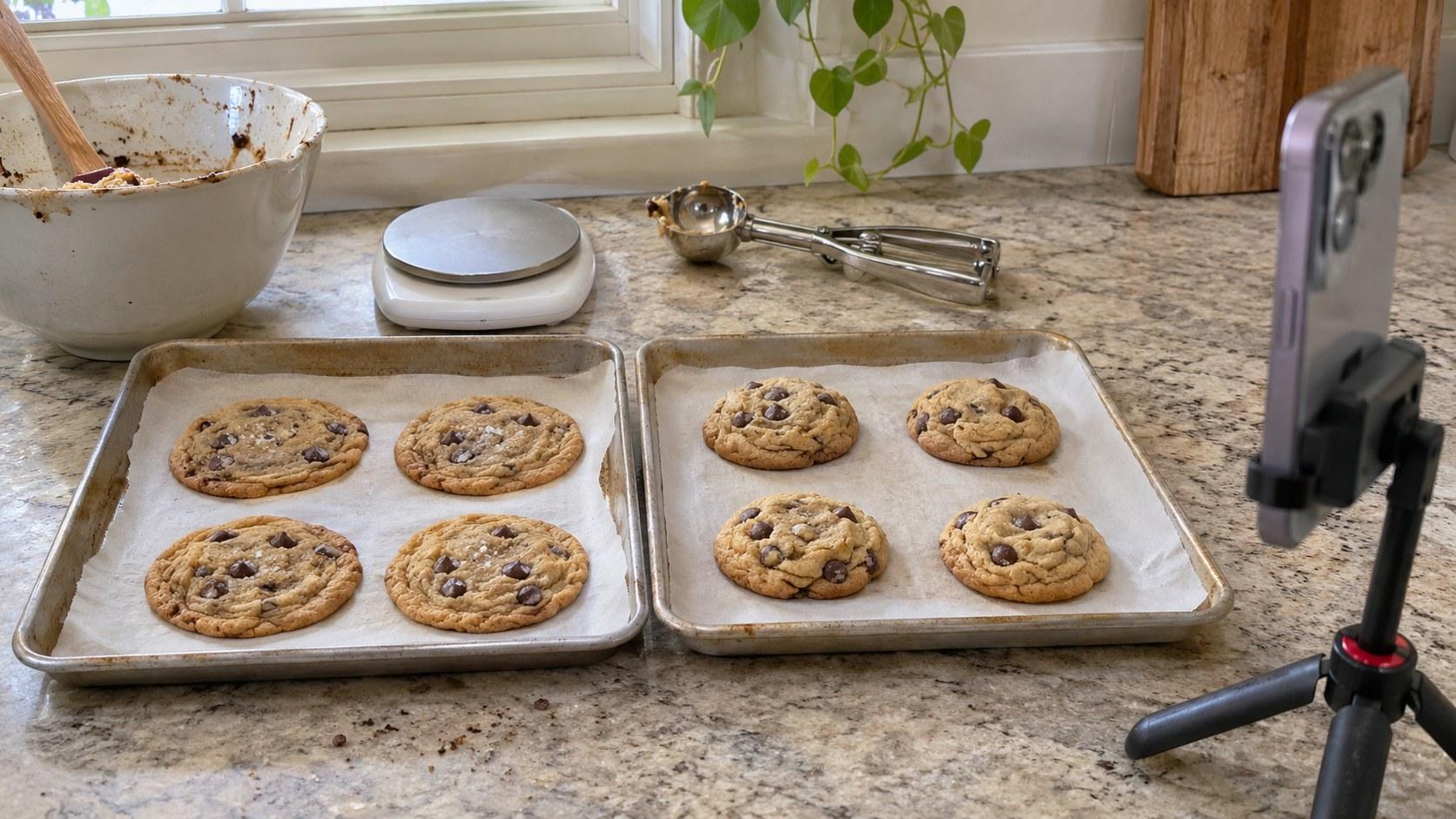
Key Takeaways
What you'll learn in this article
- Test one recipe and one chilling interval with equal-mass portions from the same dough batch.
- Keep pan temperature, lining, portion shape, oven settings, and cooling time consistent enough to make the comparison useful.
- Show the full test group at the same camera scale instead of selecting the most dramatic pair.
- Use the result to answer a baking question, then use account data to plan how to present the next lesson.
Key Takeaways
- Test one recipe and one chilling interval with equal-mass portions from the same dough batch.
- Keep pan temperature, lining, portion shape, oven settings, and cooling time consistent enough to make the comparison useful.
- Show the full test group at the same camera scale instead of selecting the most dramatic pair.
- Use the result to answer a baking question, then use account data to plan how to present the next lesson.
To make useful cookie TikToks about chilling dough, film a small, documented comparison: bake equal portions from one batch before and after a clearly stated refrigerator rest, then show the cooled cookies together at the same scale. Explain what happened with that recipe rather than promising that one chilling time fixes every spreading problem.
This is a creator filming workflow, not a new recipe or a laboratory experiment. It helps you turn “Do I really need to chill this?” into a post viewers can inspect and use. The cover image is an illustrative creator setup, not evidence from a completed baking test.
Pick a question your batch can answer
“Does chilling matter?” is too broad for a single kitchen video. A more useful question is: “With this chocolate chip cookie recipe and this portion size, how did the spread change after the recipe's refrigerator rest?”
That wording gives the viewer the conditions behind your answer. It also keeps the post from drifting into ingredient substitutions, oven troubleshooting, and texture preferences all at once.
There is a sound reason to investigate chilling. In King Arthur Baking's published cookie-dough comparison, equal-weight cookies baked after refrigeration spread less than cookies baked immediately. That is an existing baking demonstration, not your result and not a universal schedule for every dough.
Choose a recipe you have permission to share or link to its original source. Follow its method for the main batch. If you deliberately bake a few portions without a required rest, identify those as the experimental departure; do not quietly rewrite the recipe for viewers.
Before recording, write your question and intended comparison in one sentence. If the sentence contains both a flour swap and a chilling change, remove one variable.
Portion once, then keep a simple batch log
Prepare one dough batch so the comparison does not depend on two separate mixing sessions. Portion the dough consistently before dividing it into test groups, unless the recipe requires a different handling sequence. Record any departure from the original method.
Use a kitchen scale to check portion mass rather than assuming every scoop holds the same amount. Keep the shape consistent too: a flattened disc and a tall mound are not equivalent starting points simply because they weigh the same.
Your private log should contain:
- Recipe source and any intentional change.
- Portion mass and shape.
- Number of cookies in each test group.
- Refrigerator entry and removal times.
- Time spent outside the refrigerator before baking.
- Pan, lining, oven setting, rack position, and baking duration.
- Cooling duration before measurement and filming.
You do not need to put this entire log on screen. It exists so your captions describe what actually happened instead of reconstructing it from memory.
Keep the chilled portions covered as the recipe directs, and avoid leaving dough on the counter while you repeatedly adjust the camera. Set the shot before bringing the dough out. A claimed refrigerator interval becomes less informative if the portions then spend an unrecorded stretch warming under lights.
Prevent the baking sheet from becoming the hidden variable
A convincing edit cannot repair mismatched baking conditions. If the first group goes onto a cool sheet and the second goes onto the same sheet while it is hot, the video is no longer a clean illustration of the chilling step.
King Arthur's guide to why cookies spread specifically warns that a hot pan warms the dough before it reaches the oven. The guide also identifies other contributors, including ingredient ratios, butter temperature, and oven conditions. Chilling is one possible influence, not a diagnosis for every flat cookie.
For a practical home comparison:
- Use the same sheet after it has fully cooled, or matching sheets with comparable starting temperatures.
- Use the same lining and leave similar space between portions.
- Let the oven return to the intended condition between batches; use an oven thermometer if available.
- Keep the rack position and baking procedure consistent.
- Record actual baking durations, including any difference needed to reach the recipe's intended endpoint.
Do not force an underbaked batch into a tidy comparison just to claim identical timing. If the groups need different bake times, disclose that and narrow your conclusion. You are showing the outcome of two documented preparation paths, not isolating every physical mechanism.
Sequential home-oven batches still have limitations. Oven cycling and the additional time since mixing can affect the comparison. Describe it as your recipe-specific kitchen test, not proof that dough temperature alone caused the result.
Film the evidence before filming the reveal
For cookie TikToks, the most useful shots are the ones that let viewers reconstruct the comparison. A dramatic break-apart shot can come later.
Show the equal starting portions
Film the scale check and the shaped portions. Keep the scale readable in the real footage, and hold the shot long enough to understand it. You can explain the common portion mass once rather than displaying every measurement.
Track the groups in your notes or with markers safely away from the food and oven. Do not rely on remembering which tray was which after several camera changes.
Preserve the chilling interval
Capture the group going into the refrigerator, then record the actual elapsed time in the finished video's caption or narration. A quick door-closing transition illustrates the step; it does not establish the duration by itself.
Avoid turning your observed interval into a command for all recipes. “This group rested for the time specified in the linked recipe” is more useful than “Everyone must chill dough this long.”
Compare after equivalent cooling
Photograph each group after the same cooling interval, then show the cooled groups together. Keep the camera height, angle, lighting, and zoom consistent. A cookie placed closer to the lens can look larger without having spread more.
Include a ruler in the same plane as the cookies if diameter is central to your claim. For irregular cookies, state how you measured rather than presenting a rough estimate as precision. Show the whole test group and describe variation; do not pick the widest cookie from one tray and the smallest from the other.
For thickness, add a low side view on a level surface. If you break cookies open, compare them at a similar cooled state and distinguish visible structure from your personal texture preference.
Write a verdict that fits the evidence
Your conclusion should name the recipe, the comparison, and the limitation. Use your actual observations, including an inconclusive result if that is what the footage shows.
A hypothetical verdict structure would be: “With this recipe, these equal portions spread less after the refrigerator rest. I kept the pan and portion shape consistent, but this was a small home-oven test.” This is sample wording, not a reported experiment.
If the difference is barely visible, say so. You can still publish a useful lesson about what you controlled and what you would investigate next. Do not manipulate zoom, reshape the warm cookies off camera, or add a thickening ingredient to manufacture a stronger reveal.
Separate observation from preference. “This group was thicker” can be supported by the footage. “This group was better” needs a stated preference, such as wanting a thicker center, and should remain your assessment rather than an objective verdict.
Turn the comparison into a focused next-post plan
The strongest opening names the decision before the montage. For example: “Can I skip the refrigerator step in this recipe?” Another option is: “Same dough, equal portions—here is what changed after chilling.” Use those only when your footage supports the comparison.
The free hook generator can help you explore phrasing. Reject suggestions that promise a universal fix or imply a test you did not run.
Once the lesson is settled, InsightTok AI can help package it through Next Post Studio: niche-relevant sound suggestions, useful hooks, and personalized posting-time guidance. Keep narration intelligible, and choose music that supports the explanation rather than concealing it. Sound choice cannot make an uncontrolled comparison reliable.
Plan the next lesson from a specific unresolved question. If viewers ask whether the warm tray caused their spread, film a separate tray-temperature comparison. If they ask about a different flour, treat that as a new ingredient test. Do not stack every follow-up variable into one video.
Judge the lesson separately from its reach
TikTok Studio's official guidance describes account and video analytics, viewer activity times, and engagement insights including comments and future-post inspiration. Use the fields available in your interface; feature availability can vary.
Compare the post with similar baking explanations after the same observation period. Note available performance metrics, but also read whether questions concern the stated recipe, the test conditions, or an entirely different problem. Views and saves do not establish that a baking claim is correct.
For your next batch of cookie TikToks, keep two records: a baking log that supports the lesson and a content log that helps you choose the next question. InsightTok AI can support the publishing decisions; your documented kitchen work remains the evidence.
If you want help turning that next question into a hook, sound, and posting-time plan, start with Next Post Studio.
InsightTok AI Team
Expert in TikTok growth strategies and social media analytics. Helping creators reach millions with data-driven insights and AI-powered recommendations.
Ready to Grow Your TikTok?
Get AI-powered analytics and content recommendations to boost your views and engagement.
Start Free TrialRelated Posts
Piano TikTok Tutorials: Make Sustain Pedal Changes Audible
Make piano TikTok tutorials clearer with matched sustain-pedal comparisons, synchronized foot views, and audio that preserves the lesson.
Sourdough TikToks: Show Bulk Fermentation Without a Misleading Timer
A same-batch filming workflow for bread creators: show dough development, preserve real conditions, and turn fermentation questions into a useful next post.
Bookbinding TikToks: Make Paper Grain Direction Visible
Film bookbinding TikToks that make paper grain visible with an equal-overhang test, clear orientation marks, and a continuous spine-fold demonstration.